Show the method.
Respect the limits.
Our editorial standards define the rigorous principles for developing, validating, and publishing Toolvizo’s calculations, worked examples, and educational reference guides.
Editorial standards: Answer a specific question
Each tool published on Toolvizo must have a clear, well-defined purpose: estimate a quantity, compare entered values, or explain an essential mathematical relationship. Our editorial standards dictate that content must actively help visitors interpret and apply their calculated results, rather than repeat generic keywords or add filler text without adding genuine understanding.
When a reader arrives at an online calculator, they typically need immediate clarity for a real-world task—such as calculating project materials, sizing an electrical breaker, or budgeting travel expenses. Every guide accompanying a calculator directly addresses the underlying question, providing practical context, explaining standard unit conversions, and defining real-world limitations that might influence the final decision.
Explain inputs and methods
Tool pages should name each input clearly, specify its standard measurement unit, and distinguish required parameters from optional allowances. Fixed default figures should always be labeled as baselines and remain fully editable whenever the practical scenario calls for customized values.
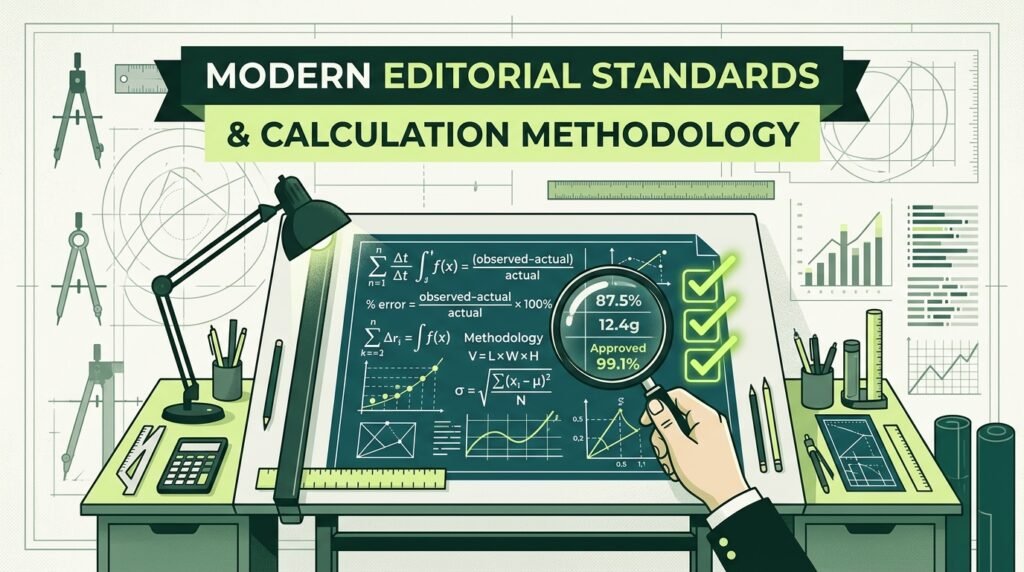
The underlying mathematical formula or computational method should appear prominently beside a worked step-by-step example. Rounding conventions, metric-imperial conversions, and baseline exclusions must be explicitly stated wherever they affect the final answer. Any calculation that relies on assumed values or statistical averages must be identified as an estimate rather than an absolute figure. This methodological transparency ensures that visitors can replicate each calculation independently and understand the mathematical principles behind every output.
Furthermore, our editorial standards require our engineering team to define the precision limits of each formula. In real-world applications, false precision—such as displaying nine decimal places for a rough concrete volume estimate—misleads users. We format results to practical significant digits while preserving raw mathematical precision in intermediate calculation steps.
Use relevant sources
Where a calculation relies on external scientific facts or standardized reference values, the page must identify the relevant primary source. This includes official protocols published by the National Institute of Standards and Technology, manufacturer technical specifications, statutory fee schedules, international industrial codes, or peer-reviewed academic research. Time-sensitive values, such as tax thresholds or financial benchmark rates, must always carry an explicit verification date.
Author, editor, and technical reviewer details must describe real people and their actual professional contributions. Credentials, testing credentials, and industry review claims must never be simulated or exaggerated. By maintaining open attribution, we ensure readers understand who built the calculation logic and who validated its real-world reliability.
Our editorial standards prohibit the reliance on secondary or unverified aggregator sites for critical formulas. If multiple competing engineering standards exist, we present the primary standard used and clearly explain the variances found in alternative models.
Check before release
The pre-release quality assurance protocol for every tool requires comprehensive verification. This includes manually checked calculation examples, unit conversion integrity, boundary case stress testing, and readable mobile responsive formatting across different screen sizes. These rigorous checks help eliminate implementation errors, although they do not certify that an abstract model applies universally to every individual circumstance.
Tools involving human health, dietary guidelines, chemical proportions, electrical wiring loads, or vehicle weight capacities require heightened scrutiny regarding source credibility and legal scope. Where qualified subject-matter review is unavailable, publication is postponed or the feature set is narrowed to keep recommendations safe and reliable.
Our editorial standards demand strict adherence to the empirical principles of the scientific method, ensuring each mathematical model is verifiable, repeatable, and clearly documented before public release.
Corrections and changes
We actively encourage reader feedback and algorithmic audits. When reporting a discrepancy, submissions should include the specific page URL, input values, chosen units, displayed result, and an explanation of why the calculated output appears incorrect. Please omit personal or confidential data from your message.
When a material correction is made to an equation or explanatory guide, the affected page documents the revision and reflects an accurate update timestamp. Dates should reflect real revisions, not simply make older material appear recent. Our editorial standards require our staff to maintain a transparent errata record, ensuring historical accuracy across all 24 interactive calculators.
Minor cosmetic improvements or spelling corrections do not alter the editorial timestamp, guaranteeing that date markers indicate meaningful methodological updates.
Commercial and AI transparency
Any affiliate placement, advertising partnership, or commercial sponsorship must be clearly labeled adjacent to the relevant content. Commercial relationships never dictate mathematical outputs, ranking positions, or editorial verdicts, nor are sponsored placements ever presented as independent editorial evaluations.
If artificial intelligence tools assist during the drafting, research, or coding phase, our editorial standards mandate human expert review at every milestone. AI-generated text is never an acceptable substitute for verified source documentation, formula verification, or professional fact-checking. Every calculation rule on Toolvizo remains human-verified, peer-reviewed, and rigorously validated.
Periodic audit & formula reviews
Calculations are never static. To uphold our editorial standards across all 24 tools, our editorial board conducts scheduled quarterly audits. These reviews verify whether external pricing models, conversion ratios, or regulatory guidelines have changed. When revisions occur, transparent changelogs are published so users can follow the rationale behind every modification.
During these routine audit cycles, our team re-tests all calculator algorithms against updated industry datasets. We maintain open communication with industry professionals, tradespeople, and educators to verify that our calculation tools reflect modern workplace conventions and dependable real-world accuracy.
By upholding these rigorous editorial standards, Toolvizo remains a trusted reference for everyday math, technical estimates, and practical planning calculations.