
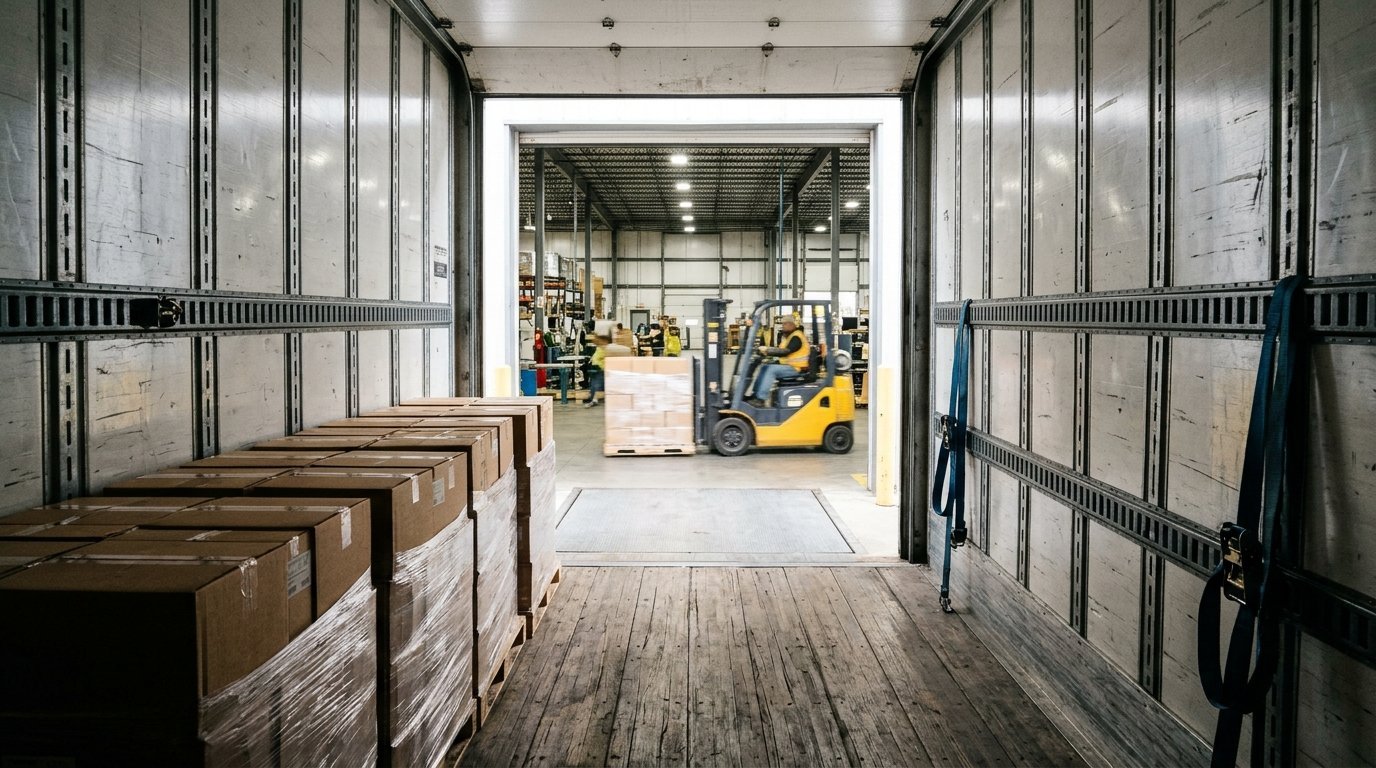
Quick Answer: How Many Pallets Fit in a 48-Foot Trailer?
A standard 48-foot dry van semi-trailer can hold 24 to 28 standard GMA pallets (48×40 inches) on the floor in a single layer. If cargo is stackable, lightweight, and uniform, double stacking increases capacity to 48 to 56 pallets. The exact count depends on pallet orientation (Straight vs. Turned), trailer type (Dry Van vs. Reefer), and DOT legal axle weight limits.
| Pallet Size & Type | Loading Pattern | Single-Stacked (Floor) | Double-Stacked (Max) | Recommended Trailer |
|---|---|---|---|---|
| Standard GMA (48×40 in) | Turned (Widthwise) | 28 Pallets | 56 Pallets | 48ft Dry Van (98.5" Inner Width) |
| Standard GMA (48×40 in) | Straight (Lengthwise) | 24 Pallets | 48 Pallets | Dry Van or Reefer (Universal) |
| Standard GMA (48×40 in) | Pinwheeled (Mixed) | 26 Pallets | 52 Pallets | Overhang Cargo / Stabilized |
| Euro Pallet (1200×800 mm) | 3 Across Lengthwise | 34 to 36 Pallets | 68 to 72 Pallets | Import / International Cargo |
| Australian Square (1165×1165 mm) | 2 Across Uniform | 22 Pallets | 44 Pallets | Transpacific Freight |
48-Foot Semi-Trailer Interior Dimensions: Dry Van vs. Reefer
While a 48-foot trailer has an exterior length of 576 inches, the actual usable interior dimensions dictate how many pallets can physically fit without damaging cargo or scraping sidewalls. Shippers must evaluate whether they are booking a standard dry van or a refrigerated trailer (reefer):
| Dimension Specification | 48ft Dry Van Semi-Trailer | 48ft Refrigerated (Reefer) Trailer |
|---|---|---|
| Usable Interior Length | 47 ft 6 in (570 to 572 in) | 46 ft 8 in to 47 ft (560 to 564 in)* |
| Usable Interior Width | 98.5 in to 99.0 in | 96.0 in to 97.0 in (Thick insulation) |
| Interior Clear Height | 106 in to 110 in | 102 in to 104 in (Duct ceiling clearance) |
| Rear Door Clearance | 98 in wide × 105 in high | 95 in wide × 100 in high |
| Max Practical Payload | 43,000 to 45,000 lbs | 41,000 to 43,000 lbs (Heavy cooling unit) |
*Note: Reefer trailers lose 8 to 12 inches of usable nose length due to the front bulkhead refrigeration unit and airflow return chute.
The 3 Pallet Loading Patterns Explained
The mathematical orientation of your pallets along the trailer floor directly dictates whether you load 24 pallets or maximize the run to 28 pallets:
1. Turned Loading (Widthwise) — 28 Pallets (Maximum Floor Yield)
In a turned configuration, pallets are loaded with their 48-inch side perpendicular to the trailer walls and their 40-inch side running down the length of the trailer.
- Width Math: Two turned pallets side by side measure
48 in + 48 in = 96.0 inches. In a modern dry van with a 98.5-inch interior width, this leaves approximately 2.5 inches of total side clearance. - Length Math: A usable length of 570 inches divided by 40 inches per row equals
570 / 40 = 14.25 rows. This accommodates 14 full rows of 2 pallets = 28 pallets total. - Why It Matters: Turning pallets delivers an immediate 16.7% capacity increase over straight loading (4 additional pallets per dispatch), drastically slashing per-pallet freight shipping costs.
Turned loading requires strict pallet packaging quality. If cardboard cartons overhang the 48-inch wooden edge by even 0.75 inches on either side, the combined width expands from 96 inches to 99 inches, causing cartons to scuff, crush, or jam against the trailer ribs during forklift loading.
2. Straight Loading (Lengthwise) — 24 Pallets (Easiest & Safest)
In a straight configuration, pallets are loaded with their 40-inch side across the width and their 48-inch side running lengthwise.
- Width Math: Two straight pallets measure
40 in + 40 in = 80.0 inchesacross. Inside a 98.5-inch trailer, this leaves an 18.5-inch center void between rows. - Length Math: 570 inches divided by 48 inches per row equals
570 / 48 = 11.875 rows, yielding 12 rows of 2 = 24 pallets total. - Best Used For: Pallets with irregular product overhang, fragile luxury retail goods, or when loading refrigerated reefer trailers where interior width (96 inches) makes turned loading impossible. Center air-bags or corrugated void fillers should be installed to prevent lateral cargo shifting.
3. Pinwheel Loading — 26 Pallets (Stabilized Hybrid)
Pinwheeling involves rotating one pallet lengthwise (40" wide × 48" long) and the adjacent pallet widthwise (48" wide × 40" long) in an alternating interlocking sequence.
- Total Width:
40 in + 48 in = 88.0 inchesacross, providing 10.5 inches of cushion space. - Total Capacity: Typically accommodates 26 pallets.
- Best Used For: Tall, top-heavy pallet stacks that are susceptible to corner sway during transit. The interlocking orientation locks the cargo together, eliminating trailer wall scuffing while maintaining higher density than straight loading.
Weight vs. Space: Understanding DOT 80,000 lbs Gross Limits
While a 48ft trailer can physically fit 28 pallets on the floor (or 56 double-stacked), freight dispatchers frequently hit legal weight limits long before running out of floor space:
- Maximum Gross Vehicle Weight (GVW): 80,000 lbs across tractor, trailer, fuel, driver, and cargo under Federal DOT Bridge Law.
- Tare Weight (Empty Equipment): A standard day cab tractor with a 48ft dry van weighs approximately 31,000 to 33,000 lbs empty.
- Net Allowable Cargo Payload: Approximately 43,000 to 45,000 lbs (or 41,000 lbs on heavier reefer units).
| Average Weight per Pallet | Physical Pallet Capacity | Total Cargo Weight | DOT Weight Compliance Status |
|---|---|---|---|
| 600 lbs (Light paper/cereal) | 28 Turned (Floor) | 16,800 lbs | ✓ 100% Legal — Eligible to Double-Stack (56 pallets) |
| 1,500 lbs (Consumer electronics) | 28 Turned (Floor) | 42,000 lbs | ✓ Legal — Optimal Full Truckload (FTL) Efficiency |
| 2,000 lbs (Canned food / beverages) | 22 Pallets Max | 44,000 lbs | ! Weighs Out at 22 Pallets (Cannot fill 28 spaces) |
| 2,500 lbs (Tile, steel hardware) | 17 Pallets Max | 42,500 lbs | ✗ Weighs Out at 17 Pallets (Trailer empty space remaining) |
Axle Weight Distribution Rule: DOT regulations mandate that total weight cannot exceed 12,000 lbs on the steer axle, 34,000 lbs on the drive tandems, and 34,000 lbs on the trailer tandems. When loading heavy freight, position dense pallets over the trailer axles rather than concentrating weight in the tail or nose.
Double Stacking Rules: How to Safely Fit 56 Pallets
Double stacking allows shippers to transport up to 56 pallets in a 48ft trailer, effectively halving per-unit shipping fees. Before double-stacking, verify the following four safety checks:
- Vertical Clearance: Standard dry van door openings measure 105 inches high. Each pallet (including the 4-inch wooden base) must not exceed 50 inches in total height to ensure a safe 5-inch ceiling clearance during forklift entry.
- Box Compression Strength (ECT): Lower cartons must carry the full top-tier load without buckling. Corrugated boxes should feature an Edge Crush Test (ECT) rating of at least 44 to 55 lbs/in.
- Anti-Slip Tier Sheets: Place heavy corrugated slip sheets between the top of the lower pallet and the base of the upper pallet to prevent vibration slippage.
- Total Scale Weight: Combined weight of all 56 double-stacked pallets must remain below the 44,000 lb legal payload limit (averaging under 785 lbs per pallet).
Comparison: 48ft Trailer vs. 53ft, 40ft, and 26ft Equipment
How does a 48ft semi-trailer compare to other standard commercial logistics vehicles? Review our standardized equipment capacity matrix:
| Vehicle / Container Type | Usable Interior Length | Standard 48×40 Pallets (Floor) | Double-Stacked Max |
|---|---|---|---|
| 53ft Semi-Trailer (Dry Van) → | 52 ft 6 in (630 in) | 26 Straight / 30 Turned | 52 to 60 Pallets |
| 48ft Semi-Trailer (This Guide) | 47 ft 6 in (570 in) | 24 Straight / 28 Turned | 48 to 56 Pallets |
| 40ft Ocean Container → | 39 ft 5 in (473 in) | 20 to 21 Pallets | 40 to 42 Pallets |
| 26ft Box Truck → | 25 ft 6 in (306 in) | 12 Straight / 14 Turned | 24 to 28 Pallets |
| 20ft Ocean Container → | 19 ft 4 in (232 in) | 10 Pallets | 20 Pallets |
Integrated Commercial Logistics Calculators
Streamline your shipping and warehouse operations with our suite of logistics calculators:
- Freight Class Calculator: Determine exact NMFC freight class (50 to 500) and pounds per cubic foot (PCF) density to eliminate carrier re-weigh surcharges.
- Pallet Packing Calculator: Optimize box layers (Ti/Hi) and maximize standard 48×40 pallet footprint utilization.
- CBM Calculator: Convert cargo cubic feet to cubic meters and calculate ocean container fill rates.
- Dimensional Weight Calculator: Calculate billable volumetric weight for FedEx, UPS, and DHL air freight.
- Dry Ice Shipping Calculator: Model cold chain sublimation rates and transit packaging for temperature-sensitive goods.