

Candle Burn Time Calculator
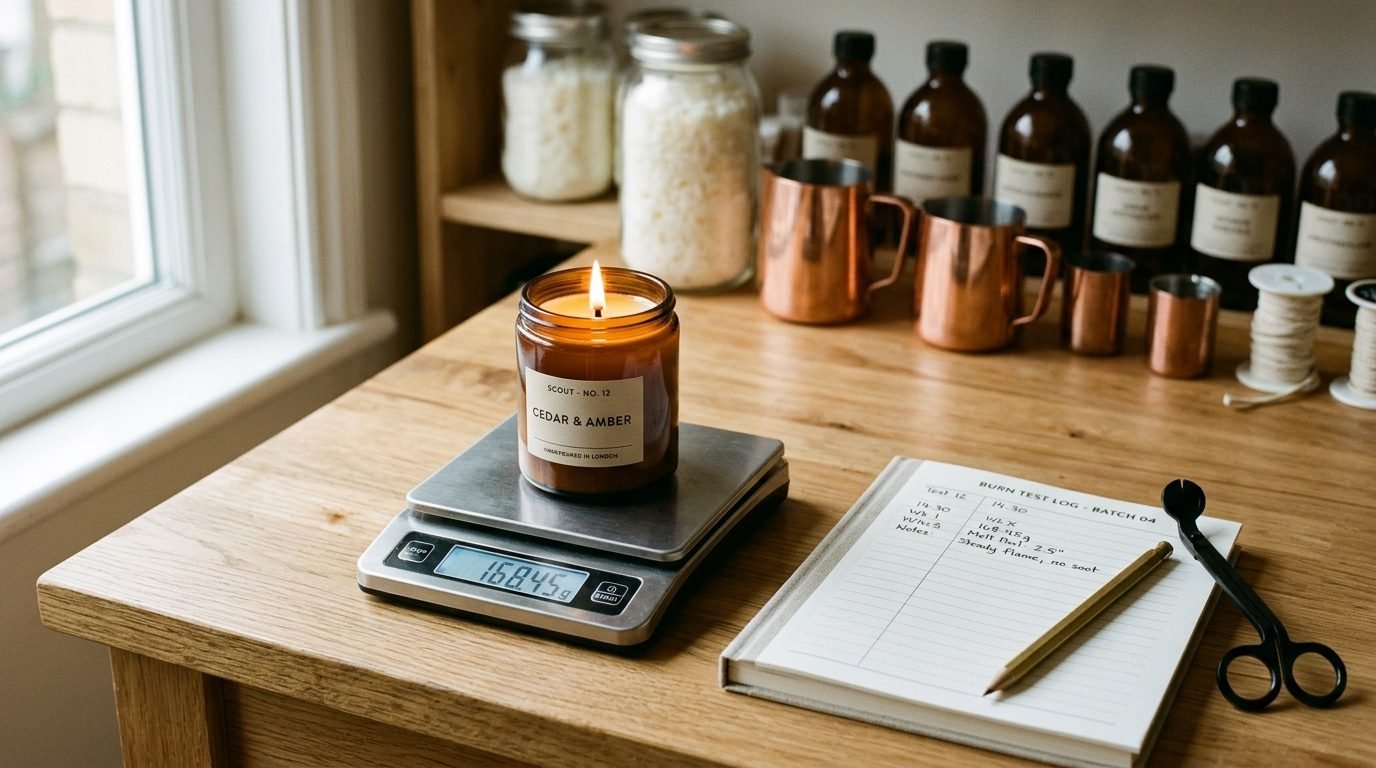
Our free candle burn time calculator helps artisanal chandlers, candle makers, and fragrance brands calculate total burn duration hours, hourly wax consumption rates, and accurate packaging label claims.
Pair this utility with our candle wick size calculator and candle wax calculator to verify combustion performance according to National Candle Association fire safety guidelines.
1. Test Burn Measurements (Grams)
2. Projected Burn Lifespan
ASTM CalibratedUsing an empirical candle burn time calculator is the standard industry method for establishing accurate product label claims. Estimating candle lifespan based on wax volume alone produces inaccurate claims that mislead customers and violate retail packaging standards.
Whether testing soy wax container jars, coconut wax luxury tins, or dense beeswax pillars, calculating true hourly mass consumption requires measuring pre-burn and post-burn scale weights across standardized burn cycles.
In this comprehensive chandlery guide, you will master the combustion chemistry behind wax consumption, evaluate burn rate benchmarks across wax types, analyze multi-wick thermal dynamics, and learn how to use a candle burn time calculator to build compliant, high-performing candles.
Table of Contents: Complete Burn Rate Engineering Guide
1. How to Measure Burn Rates and Wax Consumption Accurately
Conducting reliable tests with our candle burn time calculator takes less than five minutes of active measurement across a standard burn cycle.
Never rely on visual estimates when labeling your candles for retail distribution. Real combustion rates fluctuate based on jar diameter, wax density, and ambient humidity.
To calculate true performance, follow these four standardized laboratory steps:
- Measure Net Wax Weight: Weigh your finished, fully cured candle on a precision digital scale. Subtract the tare weight of an identical empty container, wick clip, and lid to obtain net wax weight.
- Perform a Standard 4-Hour Test Burn: Trim your wick to exactly 1/4 inch (6mm). Light the candle in a draft-free room and allow it to burn undisturbed for 4 hours.
- Record Cooled Final Weight: Extinguish the flame with a wick snuffer. Allow the liquid melt pool to resolidify completely before placing it back on your digital scale.
- Run Your Mass Loss Calculation: Enter your net wax mass, pre-burn weight, post-burn weight, and burn hours into our candle burn time calculator.
The calculator engine subtracts cooled final weight from initial weight to determine exact mass loss, generating your true hourly consumption rate.
2. Core Mathematical Formulas Behind the Candle Burn Time Calculator
Candlemaking is governed by chemical thermodynamics and mass conservation principles.
Our candle burn time calculator uses three core mathematical formulas to translate physical weight loss into reliable consumer packaging claims.
Equation 1: Hourly Consumption Rate
Hourly burn rate measures how many grams of hydrocarbon fuel vaporize every hour during steady combustion:
For example, if an 8 oz candle loses 18.0 grams over a 4.0-hour test burn, its hourly burn rate equals 4.50 grams per hour.
Equation 2: Net Usable Wax Margin
Candles must never burn entirely down to the bottom glass surface. Intense flame heat directly contacting bare glass risks thermal shock and container fractures.
According to fire safety protocols, an unburned 1/2 inch (12mm) buffer of wax must remain at the base.
Our calculation engine applies a default 95% usable wax factor, reserving 5% of wax volume for safe end-of-life extinguishment.
Equation 3: Total Projected Burn Duration
Total candle lifespan is determined by dividing net usable wax weight by the measured hourly burn rate:
Modeling these equations in our candle burn time calculator guarantees your packaging claims match real-world burn dynamics.
3. Hourly Consumption Rates by Wax Blend & Wick Architecture
Different waxes have vastly different chemical structures and melt viscosities, requiring simulation in a candle burn time calculator.
Vegetable waxes like soy wax and coconut apricot consist of dense triglycerides with high melt viscosity, feeding wicks at a moderate, controlled pace.
In contrast, petroleum-derived paraffin wax has low melt viscosity, liquefying rapidly and feeding wicks at much faster rates.
| Wax Formulation | Recommended Wick Series | Typical Burn Rate (g/hr) | Est. Hours per 200g Wax |
|---|---|---|---|
| Pure Soy Wax (GW 464, C-3) | ECO Series, CD Series | 4.0 – 5.0 g/hr | 38 – 48 Hours |
| Coconut Apricot (EC26, Ceda) | Cotton Core, Wooden Wicks | 4.2 – 5.2 g/hr | 36 – 45 Hours |
| Para-Soy Blend (IGI 6006) | HTP Series, Zinc Core | 4.8 – 5.8 g/hr | 32 – 40 Hours |
| Pure Container Paraffin (IGI 4630) | LX Series, Flat Braid | 5.5 – 7.0 g/hr | 27 – 35 Hours |
| Pure Filtered Beeswax | Square Braid Cotton | 3.2 – 4.2 g/hr | 45 – 59 Hours |
Comparing these rates inside our candle burn time calculator helps you choose the optimal wick series to balance flame safety and long burn life.
4. Step-by-Step Worked Scenarios With a Candle Burn Time Calculator
To illustrate how burn math operates in practice, examine three realistic workshop test burns calculated with our candle burn time calculator.
Scenario A: 8 oz Amber Glass Tumbler (Soy Wax GW 464)
- Net Wax Poured: 195.0 grams (6.87 oz)
- Pre-Burn Scale Weight: 348.5 grams (including jar)
- Post-Burn Weight (4-hour test): 330.1 grams
- Mass Consumed: 18.4 grams in 4.0 hours
- Hourly Burn Rate: 4.60 g/hr
- Usable Wax (95% margin): 185.25 grams
- Calculated Burn Duration: 40.3 Hours
- Packaging Label Recommendation: “Burns 40 – 45 Hours”
Scenario B: 14 oz Luxury 3-Wick Ceramic Bowl (Coconut Apricot Blend)
- Net Wax Poured: 340.0 grams (12.0 oz)
- Pre-Burn Scale Weight: 612.0 grams (heavy ceramic vessel)
- Post-Burn Weight (4-hour test): 572.4 grams
- Mass Consumed: 39.6 grams in 4.0 hours
- Hourly Burn Rate: 9.90 g/hr (total across three flames)
- Usable Wax (95% margin): 323.0 grams
- Calculated Burn Duration: 32.6 Hours
- Packaging Label Recommendation: “Burns 30 – 35 Hours”
Scenario C: 3.5 oz Travel Tin (Paraffin Blend IGI 4630)
- Net Wax Poured: 85.0 grams (3.0 oz)
- Pre-Burn Scale Weight: 118.0 grams
- Post-Burn Weight (3-hour test): 101.5 grams
- Mass Consumed: 16.5 grams in 3.0 hours
- Hourly Burn Rate: 5.50 g/hr
- Usable Wax (95% margin): 80.75 grams
- Calculated Burn Duration: 14.7 Hours
- Packaging Label Recommendation: “Burns 12 – 15 Hours”
Notice in Scenario B that although the 3-wick bowl contains 74% more wax than the 8 oz tumbler, it burns out faster due to multiple overlapping flame thermal zones.
Inputting test figures into our candle burn time calculator prevents making false lifespan assumptions based on wax volume alone.
5. Edge Cases: High Fragrance Loads, Vessel Geometry & Multi-Wicks
Candle burn rates do not remain perfectly static from the first lighting to the final heel.
When modeling burn projections in an empirical burn calculator, chandlers must account for three significant formulation edge cases.
1. High Fragrance Oil Saturation (8% to 12%)
Fragrance oils contain synthetic aromachemicals and natural essential oils that possess lower flash points than hydrocarbon waxes.
A heavy fragrance load of 10% to 12% acts as a combustion accelerant, increasing flame temperature and boosting wax draw by 8% to 12%.
Calculate your fragrance ratios accurately before test pouring using our companion candle fragrance calculator.
2. Vessel Neck Constriction and Radiant Heat Trapping
Apothecary jars and flared vessels trap ambient heat inside the container as the wax line drops into the bottom third of the vessel.
The enclosed glass walls reflect thermal radiation back into the melt pool, raising wax temperatures by 15°F to 25°F.
This thermal feedback accelerates wax liquefaction, causing candles to burn up to 15% faster during their final hours.
3. Multi-Wick Thermal Synergy Dynamics
When placing two or three wicks in a single wide container, each flame radiates heat toward adjacent wicks.
This radiant overlap produces a combined burn rate greater than the sum of isolated wicks, requiring physical verification in a standardized burn test.
Always evaluate multi-wick configurations with our candle wick size calculator to ensure proper wick spacing and prevent glass overheating.
6. ASTM Safety Protocols: Temperature Thresholds & Heel Buffers
Commercial candlemaking demands strict adherence to consumer safety benchmarks established by standard setting organizations.
The ASTM F2417 Standard Specification for Fire Safety for Candles mandates that container glass must never exceed 175°F (79.4°C) during any phase of burning.
Furthermore, safety guidelines from the National Candle Association (NCA) and fire advisories from the National Fire Protection Association (NFPA) require comprehensive testing before consumer distribution.
Core Testing Standards for Retail Compliance
- Maximum Flame Height: Flame must not exceed 3.0 inches (76mm) for containers or 2.0 inches for votives.
- Container Temperature Ceiling: Glass surface temperatures must remain below 175°F (79.4°C) at all times.
- End-of-Life Extinguishment: Flame must self-extinguish safely before burning dry against the bottom glass.
- Secondary Ignition Prohibition: Foreign matter such as match heads or wick trimmings must not ignite in the melt pool.
Using our candle burn time calculator to track burn rates across multiple 4-hour cycles ensures your candles satisfy these legal consumer safety requirements.
7. 6 Critical Testing Pitfalls That Invalidate Burn Time Claims
Testing mistakes lead to false label claims and customer returns. In reviewing laboratory logs, our team identified six frequent burn testing errors:
- Testing Before Completing Wax Cure: Burning natural soy or coconut wax within 48 hours of pouring yields inaccurate burn rates. Natural waxes require 10 to 14 days of curing for crystal structures to stabilize.
- Weighing Warm Jars With Liquid Melt Pools: Hot liquid wax continues to evaporate trace aromatics, while hot glass alters scale sensor calibration. Always allow the candle to cool completely before recording post-burn weight.
- Burning in Drafty Environments: Air currents from HVAC vents, fans, or doorways induce flame flicker. Flickering draws excess fuel into the wick, artificially inflating consumption rates by up to 20%.
- Neglecting Wick Trimming: Failing to trim the wick to 1/4 inch before each test burn allows carbon mushrooms to form, accelerating wax consumption and creating heavy soot.
- Testing Only One Burn Cycle: Burn rates accelerate as the candle burns into its lower half. Running only one initial burn test overstates total burn time by 10% to 15%.
- Calculating Total Mass Without Deducting the Heel: Expecting customers to burn 100% of wax down to the wick clip is dangerous and unrealistic. Always apply a 90% to 95% usable wax factor in your candle burn time calculator.
Double-checking these protocols with our candle burn time calculator protects your brand reputation and eliminates costly guesswork.
8. Frequently Asked Questions: Candle Burn Time Calculator & Lifespans
How long does an 8 oz soy candle burn on average?
An 8 oz container holds roughly 6.5 to 7.0 oz (185g to 200g) of net wax. In pure soy wax with an appropriately sized wick, our candle burn time calculator estimates a lifespan of 40 to 48 hours under standard 4-hour burn cycles.
Why do soy candles burn longer than paraffin candles?
Soy wax has a higher density and complex molecular structure compared to paraffin. It melts at a lower temperature and flows more slowly through the wick, burning 30% to 50% longer than paraffin candles of identical weight.
Why is the 4-hour test burn standard required?
ASTM safety standards specify 4-hour burn intervals because burning under 2 hours causes tunneling, while marathon burns exceeding 4 hours cause excessive heat buildup. The 4-hour test simulates ideal consumer usage conditions.
Why should I use a candle burn time calculator instead of estimating?
A precision candle burn time calculator converts physical scale weight loss into exact hourly burn rates, factoring in safety heel margins and preventing misleading packaging claims that frustrate customers.
Can I test multi-wick candles with this tool?
Yes. Weigh your multi-wick candle before and after a 4-hour test burn. The weight difference represents combined consumption across all wicks, which our test burn calculator computes accurately.
How does wick trimming affect total candle burn time?
Untrimmed wicks develop carbon buildup that enlarges the flame, increasing wax consumption by up to 25%. Keeping wicks trimmed to 1/4 inch ensures the candle achieves the full burn time projected by our candle burn time calculator.
Why do candles burn faster near the bottom?
As the flame descends inside the jar, the glass walls trap radiant heat, increasing melt pool temperatures. This accelerates fuel vaporization, causing candles to burn roughly 10% to 15% faster during their final third.
Explore Companion Toolvizo Candle Engineering Tools
Master your complete candlemaking mathematics with our interconnected crafting suite:
- Select calibrated wicks with our Candle Wick Size Calculator
- Calculate exact batch wax weights with our Candle Wax Calculator
- Formulate fragrance percentages with our Candle Fragrance Calculator
- Determine unit wholesale costs with our Candle Cost Calculator
- Learn wick sizing principles in our guide on how to choose candle wick size
- Browse our complete collection of free craft calculation tools
Achieve Verified Burn Times for Every Batch
Eliminate packaging guesswork and establish authentic burn claims backed by scientific test data. Use our free candle burn time calculator to build safer, longer-lasting candles today.
Calculate Your Burn Time Above ↑Our free candle burn time calculator helps artisanal chandlers, candle makers, and fragrance brands calculate total burn duration hours, hourly wick consumption rates, and wax lifespan. Labeling candles with accurate burn times is essential to consumer trust and complies with standardized ASTM F2058 candle fire safety standards. Use this candle burn time calculator alongside our free craft calculators to conduct repeatable laboratory burn tests.
How to Use the Candle Burn Time Calculator for Accurate Labeling
Using our candle burn time calculator takes less than two minutes and guarantees that packaging claims like “Burns for 45 Hours” are backed by empirical testing. Follow these four lab steps:
- Weigh Net Wax Weight: Weigh the finished cured candle in grams or ounces on a digital scale, subtract the tare weight of the empty glass vessel, wick clip, and label to obtain pure net wax weight for the candle burn time calculator.
- Conduct a 4-Hour Test Burn: Trim the wick to 1/4 inch (6 mm), light the candle in a draft-free room, and burn continuously for exactly 4 hours according to ASTM protocol.
- Record Post-Burn Weight Loss: Extinguish the flame, allow the wax pool to solidify completely, and re-weigh the candle. Enter both the initial weight and final weight into the candle burn time calculator.
- Review Estimated Total Hours & Rate: The candle burn time calculator calculates your exact hourly consumption rate (grams consumed per hour) and projects total lifespan hours down to the decimal.
Core Mathematical Formulas Powering the Candle Burn Time Calculator
Empirical candle formulation requires precise thermodynamics and mass conservation math. Our candle burn time calculator utilizes the following standard equations:
1. Hourly Consumption Rate Equation
Hourly Burn Rate (g/hr): Burn Rate = Weight Loss (g) / Test Duration (Hours)
Standardized Test Duration: 4.0 Hours (Standard ASTM Laboratory Test Cycle)
2. Total Estimated Candle Lifespan Equation
Safety Buffer Adjustment (ASTM): Usable Wax = Total Net Wax − (Unburned Heel Wax Buffer ~0.5 inch)
Ounces to Grams Conversion: Net Weight (oz) × 28.3495 = Net Weight (grams)
3. Multi-Wick Consumption Aggregation
Note: Multiple wicks generate overlapping radiant thermal zones, increasing burn rates by 10% to 15% compared to isolated single wicks in the candle burn time calculator.
7 Critical Candle Testing Conditions & Burn Rate Factors
A single lab test burn does not reflect the entire lifespan of a candle. Our candle burn time calculator accounts for seven distinct chemical and physical variables:
| Condition # | Testing Condition | Thermodynamic Dynamics & Rate Impact |
|---|---|---|
| Condition 1 | The 4-Hour ASTM F2058 Test Standard | Industry safety standards dictate burning candles in controlled 4-hour intervals. Short burns under 2 hours cause tunneling; extended burns over 4 hours overheat vessels. Entering 4-hour test cycles into this candle burn time calculator ensures legal labeling compliance. |
| Condition 2 | Wick Sizing (Over-Wicking vs. Under-Wicking) | Over-wicked candles produce huge mushrooming flames that melt wax too fast, shortening lifespan by 30% to 40% and creating black carbon soot. Under-wicked candles fail to reach the jar edge, leaving a ring of wasted wax along the sidewalls. |
| Condition 3 | Wax Viscosity & Fatty Acid Melt Points | Paraffin wax melts into a thin, watery liquid that feeds wicks quickly (5.5 – 7.5 g/hr). Natural soy and beeswax consist of complex triglycerides with high melt points and thick viscosity, feeding wicks much slower (3.5 – 5.0 g/hr) in the candle burn time calculator. |
| Condition 4 | Fragrance Oil Load Volatility (6% – 10%) | Fragrance oils act as volatile accelerants. A candle with a heavy 10% fragrance load burns 8% to 12% faster than an unscented base candle due to lowered flash points and increased flame temperatures. |
| Condition 5 | Vessel Geometry & Heat Retention | Glass apothecary jars with narrow necks trap ambient radiant heat, increasing the melt pool temperature as the flame burns down. As a candle reaches its lower third, burn rates calculated in our candle burn time calculator accelerate by 15%. |
| Condition 6 | The Initial Burn “Wax Memory” Ring | During the very first burn, a candle must form a complete edge-to-edge liquid wax pool. If extinguished prematurely at 45 minutes, a permanent memory tunnel forms, isolating outer wax and reducing effective burn life drastically. |
| Condition 7 | Ambient Drafts & HVAC Airflow Dynamics | Air drafts from ceiling fans, open windows, or AC vents force candle flames to flicker erratically. Flickering introduces turbulence that draws excess oxygen and liquid wax into the wick, accelerating wax burn-off by 15% to 20%. |
Hourly Consumption Rates by Wax Formulation & Wick Series
When modeling burn projections in our candle burn time calculator, compare your lab test results against typical industry benchmarks across major wax formulations:
| Wax Type / Brand | Recommended Wick Series | Average Burn Rate (g/hr) | Expected Hours per 7 oz (198g) Wax |
|---|---|---|---|
| Pure Soy (Golden Wax 464, C-3) | CD Series, ECO Series, Premier 700 | 4.0 – 5.0 g/hr | 40 – 49 Hours |
| Coconut Apricot (EC26, Ceda Serica) | Cotton Core, Wooden Wicks, CDN | 4.2 – 5.2 g/hr | 38 – 47 Hours |
| Para-Soy Blend (IGI 6006) | Zinc Core, HTP Series | 4.8 – 6.0 g/hr | 33 – 41 Hours |
| Pure Paraffin Container (IGI 4630) | Flat Braid, LX Series | 5.5 – 7.2 g/hr | 27 – 36 Hours |
| Pure Filtered Beeswax | Square Braid Cotton | 3.2 – 4.2 g/hr | 47 – 61 Hours |
Real-World Case Studies Tested in the Candle Burn Time Calculator
To examine the scientific relationship between wax mass and wick selection, review two realistic test burns calculated through our candle burn time calculator:
Case Study 1: 8 oz Amber Glass Soy Candle (Single CD-18 Wick)
Candle Specs: Golden Wax 464 with 8% lavender fragrance oil. Net wax fill is 195 grams (6.87 oz). A 4-hour test burn is conducted in a draft-free chamber:
Post-Burn Weight (4 hrs): 330.1 g
Net Wax Consumed: 18.4 grams
Heel Wax Deduction: 15 g safety
Net Usable Wax: 180.0 grams
Our candle burn time calculator confirms this candle can be safely marketed with an authentic packaging claim of “Burns 38 – 40 Hours”.
Case Study 2: 14 oz Luxury 3-Wick Ceramic Bowl (Triple Cotton Wicks)
Candle Specs: Coconut apricot wax in a 4.5-inch diameter ceramic vessel holding 340 grams of wax. Tested with three small ECO-2 wicks:
4-Hour Burn Weight Loss: 39.6 grams
Hourly Burn Rate: 9.90 g/hr
Thermal Synergy Factor: +10% rate
Usable Wax (Heel off): 315 grams
The candle burn time calculator demonstrates that despite holding 74% more wax than the 8 oz jar, the 3-wick setup burns out in ~32 hours due to high triple-flame consumption.
5 Pro Chandlery Strategies to Maximize Candle Burn Duration
Experienced candle chandlers use our candle burn time calculator to optimize wick selection and extend candle burn duration:
- Trim Wicks to 1/4 Inch (6mm) Before Every Burn: Untrimmed wicks develop carbon “mushrooms” that draw up to 30% more liquid wax into the flame. Emphasizing wick trimming on warning labels ensures customers achieve the full lifespan predicted by this candle burn time calculator.
- Cure Vegetable Waxes for Minimum 14 Days: Soy and coconut waxes undergo polymorphic crystallization after pouring. Burning a candle after only 48 hours results in faster melting and lower scent throw. A full 14-day cure stabilizes crystal bonds and slows the burn rate calculated in our candle burn time calculator.
- Step Down One Wick Size If Sidewalls Overheat: If your container reaches temperatures above 140°F (60°C) during hour 3 of your test burn, step down to a smaller wick size. This drops consumption by roughly 0.6 g/hr and extends total burn time by 5 to 8 hours.
- Calibrate Fragrance Load at 7% to 8%: While some chandlers push fragrance loads to 10% or 12%, heavy oil loading clogs wicks or accelerates flame heat. Formulating at 7% to 8% delivers maximum cold and hot scent throw without compromising the burn duration calculated in our candle burn time calculator.
- Conduct End-of-Life Safety Extinguishment Tests: When testing candles through our candle burn time calculator, always verify that the flame self-extinguishes safely when 1/2 inch of wax remains to avoid glass thermal cracking.
Frequently Asked Questions About Candle Burn Times
How long will an 8 oz candle burn?
An 8 oz container holds approximately 6.5 to 7.0 oz (185g to 200g) of actual wax by weight after leaving 1/2 inch headspace. In natural soy wax with a properly sized cotton wick, our candle burn time calculator estimates a total burn time of 40 to 48 hours.
Why did my candle burn faster than the label claimed?
Candles burn faster than estimated if wicks are left untrimmed, if burned in drafty rooms, or if burned for extended marathon sessions over 4 hours. Using our candle burn time calculator to establish conservative burn time ranges protects brands from customer dissatisfaction.
What is the 4-hour candle burn testing rule?
ASTM candle safety standards dictate burning candles in controlled 4-hour cycles. After 4 hours, extinguish the candle, let it cool completely, weigh the wax loss, and enter the numbers into this candle burn time calculator to determine the true hourly burn rate.
Does soy wax burn longer than paraffin wax?
Yes. Soy wax has a higher chemical density and lower melt temperature than paraffin wax. On average, soy wax burns 30% to 50% longer than paraffin candles of the same weight, as verified in our candle burn time calculator.
How does candle diameter affect burn time?
Wider candles require larger or multiple wicks to achieve a full melt pool to the jar edge. Because wider wicks consume more grams of wax per hour, wider candles often burn through their wax volume faster than tall, narrow pillar candles of identical weight.
Why must you leave 1/2 inch of unburned wax at the bottom?
When a candle burns down to the bare glass base, the flame’s intense heat transfers directly to the bottom glass without wax to absorb the thermal energy. This can crack glass vessels or scorch tabletops. Our candle burn time calculator factors this safety margin into net usable wax calculations.
Can I calculate multi-wick candles with this tool?
Yes. Weigh the multi-wick candle before and after a 4-hour test burn. The weight difference reflects total combined consumption across all wicks, which our candle burn time calculator translates into accurate total burning hours.