
Direct Answer
Dry Ice Shipping Pounds Formula
Dry ice sublimates at a predictable rate of 5 to 10 pounds (2.25 to 4.5 kg) per 24 hours inside a standard 1.5-inch insulated EPS cooler. To calculate required dry ice: Pounds Required = (Transit Hours ÷ 24) × Daily Sublimation Loss + Buffer. For a standard 48-hour shipment, pack 15 to 20 lbs of dry ice to guarantee frozen delivery during carrier delays.
Sublimation Loss Physics
UN 1845 Air Compliance
Dry Ice Shipping Calculator
Calculate exact dry ice sublimation loss, required refrigerant weight in pounds and kilograms, cooler volume displacement, and carrier compliance.
How much dry ice is needed for shipping? A standard insulated EPS foam cooler sublimates 5 to 10 pounds (2.3 to 4.5 kg) of dry ice every 24 hours. For standard domestic shipping: pack 5–10 lbs for 24-hour transit, 10–20 lbs for 48 hours, and 15–30 lbs for 72 hours. Add a 20% safety buffer for warm summer temperatures (>85°F / 29°C) or non-frozen payload.
Transit Time & Cooler Insulation
Cold Chain Protection Buffer
Shipment exceeds 5.5 lbs (2.5 kg). Mandatory UN 1845 Class 9 diamond hazard placard and net weight declaration required for air shipping.
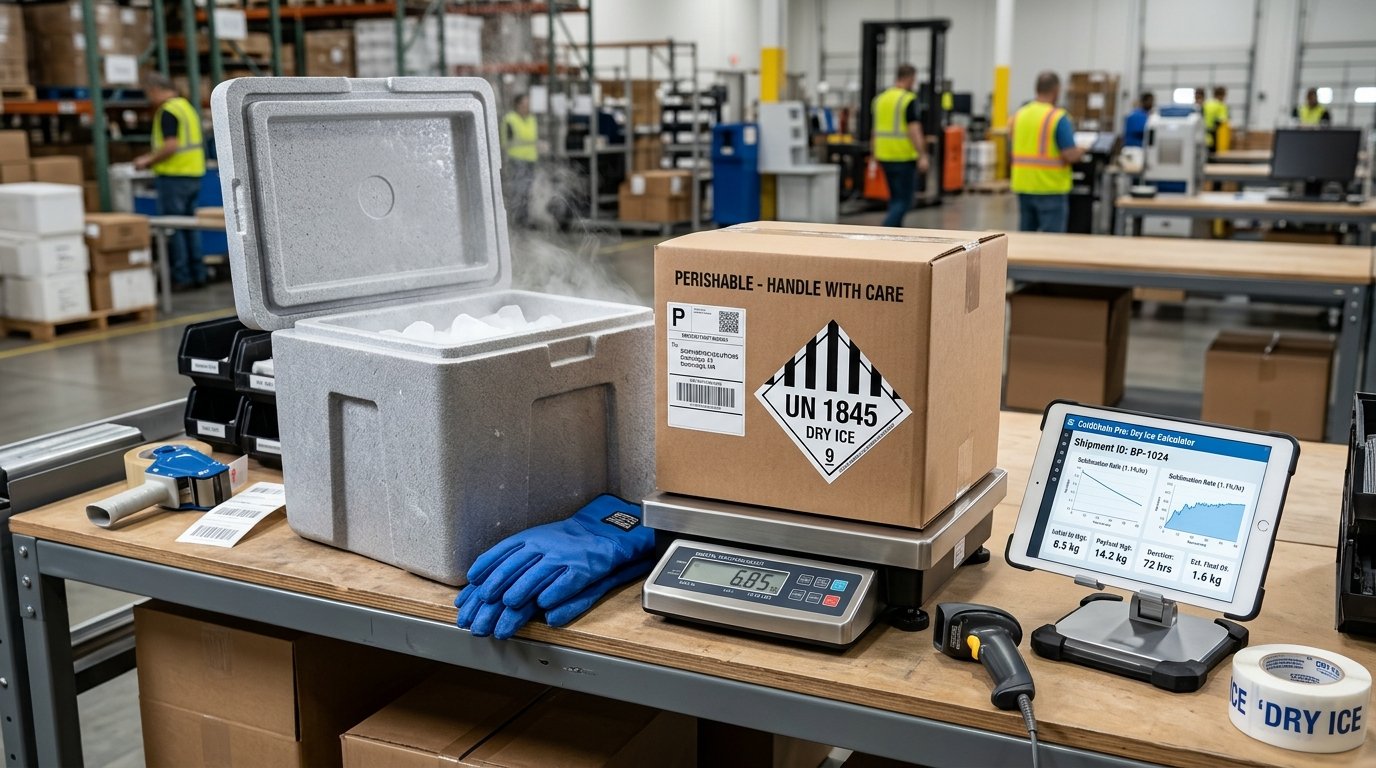
Table of Contents: 2026 Dry Ice Shipping Guide
- What is Dry Ice Shipping and Why Does Sublimation Matter?
- Understanding Dry Ice Sublimation Rates by Container Type
- Cold Chain Calculation Formulas: Pounds, Kilograms, and Transit Hours
- Carrier Regulations and UN 1845 Compliance (FedEx, UPS, USPS)
- How Our Dry Ice Shipping Calculator Computes Sublimation Rates
- Real-World Cold Chain Case Studies: Steaks, Breast Milk, and Pharmaceuticals
- Why Cold Chain Shippers Rely on a Dry Ice Shipping Calculator
- 5 Step-by-Step Packout Best Practices for Safe Dry Ice Shipping
- Frequently Asked Questions About Dry Ice Shipping and Cold Chain Logistics
What is Dry Ice Shipping and Why Does Sublimation Matter?
Transporting temperature-critical frozen goods requires a precise dry ice shipping calculator to compute sublimation loss and ensure products arrive frozen.
Dry ice represents the solid state of carbon dioxide (CO2). It maintains an equilibrium temperature of minus 109.3 degrees Fahrenheit.
Unlike ordinary water ice or commercial gel packs, dry ice never melts into messy liquid slurry as ambient heat penetrates containers.
Instead, dry ice sublimates directly into expanding gas, which our dry ice shipping calculator models using thermal resistance curves.
Because sublimation continuously dissipates solid refrigerant mass, fulfillment engineers must plan for ongoing weight loss across every transit hour.
Using our calibrated dry ice shipping calculator guarantees your packout maintains sufficient solid refrigerant through final destination unboxing.
Checking refrigerant loss in our thermodynamic modeling engine prevents temperature excursions that ruin sensitive biologicals and gourmet food.
Understanding Dry Ice Sublimation Rates by Container Type
Sublimation velocity depends on container insulation efficiency, wall thickness, exterior ambient temperatures, and refrigerant surface area.
Inside standard 1.5-inch expanded polystyrene (EPS) coolers, dry ice sublimates at five to 7.5 pounds every twenty-four hours.
High-efficiency shippers lined with polyurethane or vacuum insulated panels restrict thermal bridging, modeled reliably in our dry ice shipping calculator.
Conversely, thin thermal bubble pouches permit rapid heat transfer, consuming ten to fourteen pounds of dry ice daily.
Selecting your cooler specification in our dry ice shipping calculator generates customized refrigerant targets matching your packaging thermal boundary.
Comparing container loss across cold chain insulation charts empowers fulfillment teams to select cost-effective insulated shippers.
For consolidated freight requiring multi-pallet air or sea containers, determine cargo volume with our CBM calculator and CBM to KG Freight Conversion, how to calculate CBM guide.
Sublimation Rate Benchmark Across Common Insulated Shippers
| Cooler Insulation Material | Wall Thickness | Daily Loss (24h) | Recommended Freight Application |
|---|---|---|---|
| Standard Molded EPS Styrofoam | 1.5 inches | 5.0 to 7.5 lbs (2.3 to 3.4 kg) | Overnight frozen steaks, gourmet seafood, pastries |
| Heavy-Duty Molded EPS Foam | 2.0 to 2.5 inches | 4.0 to 5.5 lbs (1.8 to 2.5 kg) | 48-hour frozen poultry, ice cream tubs, biologicals |
| Polyurethane / VIP Vacuum Panels | 1.5 to 2.0 inches | 2.5 to 4.0 lbs (1.1 to 1.8 kg) | 72-hour clinical trials, pharmaceutical vaccines, genetics |
| Biodegradable Paper / Denim Coolers | 1.25 inches | 6.5 to 9.0 lbs (2.9 to 4.1 kg) | Eco-friendly frozen meal delivery kits (24-36h) |
| Thin Foil Bubble Mailer Sleeves | 0.25 inches | 11.0 to 15.0 lbs (5.0 to 6.8 kg) | Short same-day couriers (under 8 hours only) |
Verifying cooler insulation ratings in our dry ice shipping calculator prevents costly overpacking while eliminating product thawing risks.
Cold Chain Calculation Formulas: Pounds, Kilograms, and Transit Hours
Disciplined cold chain planning replaces risky guesswork with thermodynamic refrigeration calculations based on transit hours and packaging ratings.
Our responsive dry ice shipping calculator determines baseline hourly sublimation loss from container ratings and ambient environmental factors.
Hourly Sublimation Rate (lbs/hr) = (Daily Loss Constant ÷ 24) × Form Factor × Climate Multiplier
Solid blocks expose less exterior surface area than extruded pellets, a physical distinction captured inside our dry ice shipping calculator.
Next, multiply hourly sublimation loss by transit hours, then apply an essential logistics safety buffer.
Total Recommended Dry Ice (lbs) = (Hourly Loss Rate × Transit Hours) × Safety Buffer Multiplier
Standard logistics protocols recommend adding at least twenty percent safety buffer to withstand delayed flights or missed deliveries.
To convert dry ice mass into metric kilograms for international airway documentation, multiply total pounds by 0.453592.
Metric Weight (kg) = Total Dry Ice Pounds × 0.453592
Testing these formulas in our dry ice shipping calculator guarantees frozen parcels endure unanticipated weekend transport bottlenecks.
Calculating packout mass through our refrigeration model ensures accurate declaration on commercial courier air waybills.
Carrier Regulations and UN 1845 Compliance (FedEx, UPS, USPS)
Because sublimating dry ice releases carbon dioxide gas and displaces breathable air in aircraft holds, carriers classify it as dangerous cargo.
Under international aviation safety mandates, dry ice carries hazardous code UN 1845, tracked automatically by our dry ice shipping calculator.
As documented in the official FedEx dry ice shipping guidelines, air parcels must declare net dry ice weight on outer shipping labels.
According to FAA PackSafe dry ice regulations, passenger aircraft enforce strict maximum refrigerant weight boundaries.
Parcels exceeding 5.5 pounds (2.5 kg) flying via air require a Class 9 diamond hazard placard, highlighted by our dry ice shipping calculator.
For sensitive healthcare and clinical shipments, consult the CDC vaccine cold chain storage toolkit for temperature monitor protocols.
Carrier Dry Ice Shipping Requirements Summary
| Carrier & Service Mode | Maximum Allowed Weight | Required Outer Package Markings | Special Handling Surcharges |
|---|---|---|---|
| FedEx Express (Air) | Varies by aircraft (typically 200 kg) | UN 1845, Dry Ice, Net Weight in kg, Class 9 Diamond (>2.5 kg) | Standard dry ice administrative surcharge applies |
| FedEx Ground | Standard 150 lbs parcel ceiling | ‘Dry Ice – For Food/Medical’ + Net Weight in kg | No dangerous goods air surcharge on ground moves |
| UPS Next Day / 2nd Day Air | Subject to airline payload restrictions | Class 9 Diamond (>2.5 kg), UN 1845, Net Weight in kg | Dry ice handling fee assessed per package |
| UPS Ground | 150 lbs maximum carton limit | Clear marking: Dry Ice / UN 1845 + net mass in kg | Exempt from air hazardous paperwork |
| USPS Priority Mail | 5.0 lbs maximum dry ice limit | Dry Ice UN 1845 marking, commercially sealed food/medical | Domestic air mail accepts ≤ 5.0 lbs only |
Checking carrier limits inside our dry ice shipping calculator prevents package rejections during automated distribution center scans.
How Our Dry Ice Shipping Calculator Computes Sublimation Rates
Our interactive dry ice shipping calculator transforms complex thermodynamic formulas into a fast, intuitive packaging dashboard.
Begin by selecting expected transit duration, spanning twelve-hour regional couriers to ninety-six-hour global air cargo.
Next, choose your cooler insulation profile and specify whether you are loading dense solid blocks or extruded rice pellets.
Designate ambient weather conditions, enabling the algorithm to adjust for extreme ninety-degree summer airport tarmac temperatures.
Our dry ice shipping calculator computes total recommended refrigerant weight in pounds and kilograms alongside automated compliance alerts.
If your shipment exceeds the 5.5-pound air threshold, the dry ice shipping calculator displays an immediate reminder to affix the Class 9 placard.
Verifying cooler displacement dimensions ensures you avoid oversize carrier fees, cross-checked easily on our dimensional weight calculator.
Real-World Cold Chain Case Studies: Steaks, Breast Milk, and Pharmaceuticals
Examining practical logistics scenarios illustrates how differing payload sensitivities demand tailored dry ice volumes and container geometries.
Case Study 1: E-Commerce Gourmet Wagyu Steaks (Overnight Air)
An artisanal butcher ships three pounds of frozen prime wagyu steaks across two national flight zones.
Fulfillment uses a 1.5-inch EPS styrofoam cooler with twenty-four-hour overnight priority delivery.
Entering packaging details into our dry ice shipping calculator indicates an 8.6-pound baseline sublimation loss for extruded pellets.
Applying a twenty percent buffer yields 10.4 pounds of dry ice, ensuring 1.8 pounds remain solid upon recipient unboxing.
Because refrigerant weight exceeds 5.5 pounds (4.7 kg), the merchant affixes the UN 1845 Class 9 diamond hazard placard.
The steaks arrive frozen rock-solid, earning glowing customer reviews and repeat retail subscriptions.
Case Study 2: Relocating Frozen Mother’s Breast Milk (48-Hour Ground)
A traveling mother ships 150 ounces of frozen breast milk across 600 miles via forty-eight-hour ground transit.
The mother packs milk bags inside a two-inch EPS cooler utilizing solid dry ice blocks instead of pellets.
Solid blocks lose roughly 4.5 pounds daily in mild spring weather, totaling nine pounds of sublimation loss.
Applying a twenty percent safety buffer in our dry ice shipping calculator recommends eleven pounds of solid block ice.
Because the carton travels via ground delivery rather than passenger planes, Class 9 air paperwork is legally waived.
The consignment arrives with two pounds of intact dry ice, preserving precious infant nourishment without temperature deviation.
Case Study 3: Clinical Biorepository Tissue Samples (72-Hour VIP Shipper)
A biomedical laboratory transfers cryogenic biopsy samples between research hospitals over a seventy-two-hour flight window.
Engineers utilize a certified vacuum-insulated panel shipper that restricts daily sublimation loss to three pounds.
Over seventy-two hours, baseline sublimation consumes nine pounds of dry ice in climate-controlled cargo compartments.
Our dry ice shipping calculator applies a thirty percent pharmaceutical buffer, yielding 11.7 pounds (5.3 kg) total dry ice.
The laboratory completes IATA dangerous goods paperwork and displays the UN 1845 diamond placard with exact net weight in kilograms.
Digital temperature monitors confirm interior temperatures remained below minus seventy degrees Celsius throughout the entire international flight.
Why Cold Chain Shippers Rely on a Dry Ice Shipping Calculator
Managing perishable cold chain logistics without a scientific dry ice shipping calculator exposes companies to devastating financial liabilities.
Underpacking refrigerant causes thawed meat, spoiled biologicals, and ruined medicine, which our dry ice shipping calculator prevents through calibrated safety buffers.
Conversely, overpacking dry ice inflates package deadweight, triggering massive courier transportation surcharges on every outbound carton.
Our calibrated dry ice shipping calculator strikes an optimal equilibrium, maintaining thermal safety while eliminating excessive freight overhead.
Automated regulatory alerts in the dry ice shipping calculator prevent costly safety fines and flight groundings by aviation inspectors.
Consistently modeling shipments with reliable cold chain software protects brand trust, legal compliance, and commercial profit margins.
To evaluate overall sales margins across multi-channel perishable food businesses, review unit economics on our ecommerce profit calculator.
5 Step-by-Step Packout Best Practices for Safe Dry Ice Shipping
Mastering physical packaging techniques is just as vital as calculating refrigerant weight to ensure successful cold chain deliveries.
1. Never Hermetically Seal Dry Ice Containers
As dry ice sublimates, it expands into gas at an enormous volumetric ratio of approximately 845 to one.
Placing dry ice inside an airtight plastic container or vacuum-taped cooler generates dangerous internal pressure.
Trapped pressure will rupture container walls violently, causing an explosive decompression during transport.
Always allow expanding gas to vent harmlessly while taping outer box seams to prevent external draft convection.
2. Eliminate Interior Air Voids with Paper Dunnage
Trapped ambient air inside an insulated cooler accelerates convective warming, increasing sublimation speed.
Fill all empty space around your product and dry ice with crumpled kraft paper, corrugated pads, or packing peanuts.
Minimizing dead air pockets keeps cold thermal energy concentrated around perishable payload merchandise.
3. Position Dry Ice Correctly Inside the Cooler
Dense cold air sinks while warm air rises; therefore, position dry ice on top of or surrounding merchandise.
Placing dry ice exclusively beneath products leaves top surfaces exposed to warming currents during transport.
Wrap products in barrier plastic to prevent freezer burn caused by direct contact with minus 109-degree refrigerant.
4. Wear Cryogenic Protective Gloves and Eye Protection
Direct skin contact with dry ice causes instant cellular frostbite and severe thermal burns within seconds.
Always handle solid blocks and pellets using insulated cryogenic safety gloves, protective goggles, and plastic scoops.
Ensure packaging packout rooms maintain active fresh air ventilation, and reference our dry ice shipping calculator to stage appropriate quantities.
5. Declare Accurate Net Dry Ice Weight on Carrier Labels
Airlines balance cargo bays and calculate aircraft ventilation rates based on declared hazardous carbon dioxide manifests.
Never approximate dry ice weight on airway documentation; always weigh completed packouts on calibrated digital scales.
Enter exact net dry ice kilograms on your shipping label to maintain strict compliance with IATA and FAA regulations.
2026 Freight, Logistics & Shipping Calculation Hub
Standardized dimensional math, freight class density formulas, and cargo container capacity tools:
Frequently Asked Questions About Dry Ice Shipping and Cold Chain Logistics
How fast does dry ice sublimate during transit?
Inside standard 1.5-inch EPS coolers, dry ice sublimates at five to 7.5 pounds every twenty-four hours. Premium vacuum panel coolers reduce loss to 3.5 pounds.
What is the UN number for shipping dry ice by air?
Dry ice carries hazard code UN 1845 under Dangerous Goods Class 9. Air packages must display UN 1845, proper name, and net weight in kilograms.
When is a Class 9 Diamond Hazard label required for dry ice?
Air shipments containing more than 5.5 pounds (2.5 kg) of dry ice require a black-and-white striped Class 9 diamond hazard placard on the outer box.
Can you ship dry ice via USPS Priority Mail?
USPS allows domestic mail containing up to 5.0 pounds of dry ice. Parcels must display UN 1845 markings and contain commercially prepared refrigerated food or medicine.
Why is it dangerous to tape an insulated cooler completely airtight?
Dry ice expands roughly 845 times in volume as it sublimates. Sealed airtight containers build explosive internal pressure that can violently rupture in transit.
How does a dry ice shipping calculator prevent product spoilage?
A dry ice shipping calculator computes exact hourly sublimation loss from container insulation and transit time, ensuring products remain frozen without spoilage.
Explore Related Packaging, Freight & Logistics Calculators
Optimize your cold chain freight, calculate dimensional parcel weights, or streamline warehouse packouts with our free tools: