
Candle Wick Size Calculator: Free Complete Wicking Tool (2026)
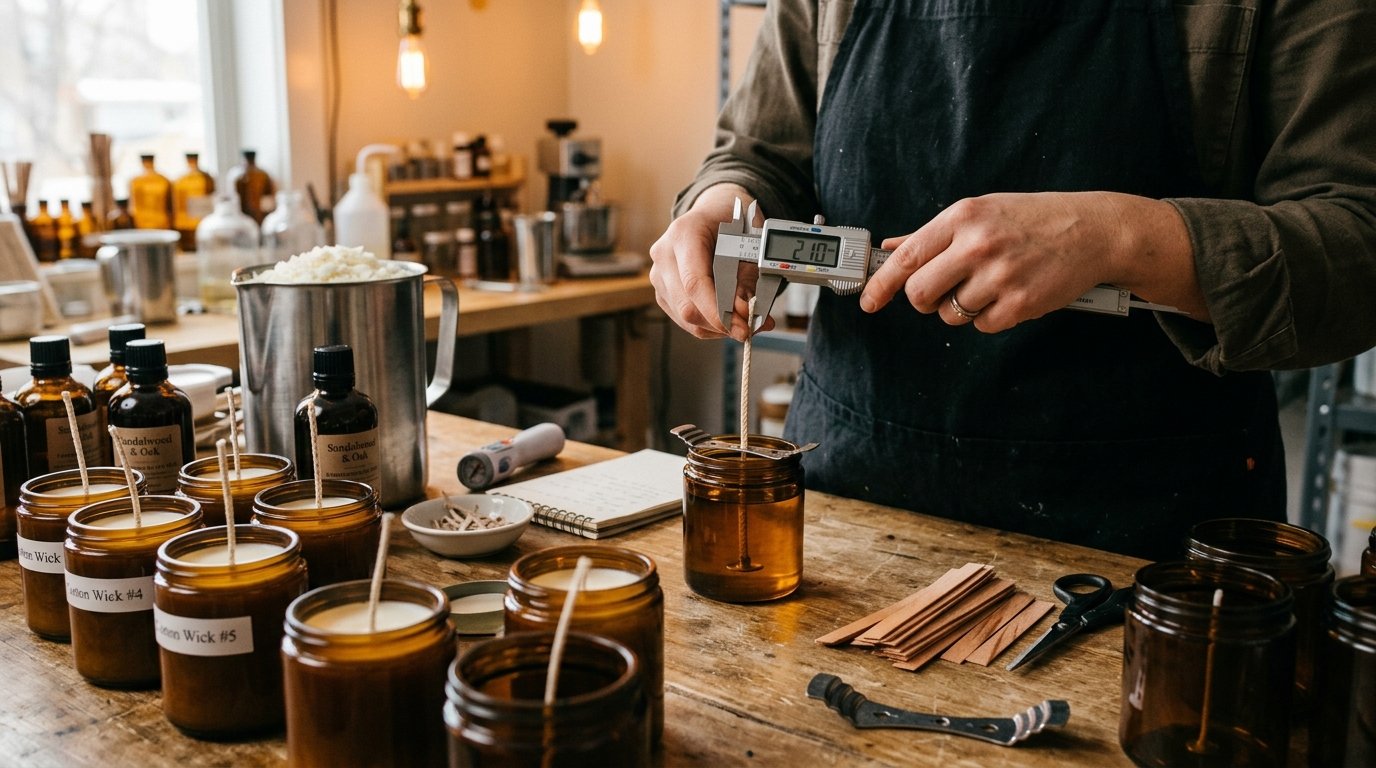
Calculate the perfect cotton or wooden wick size for soy, beeswax, or coconut candles across any jar diameter with our free candle wick size calculator.
What size wick do I need for my candle? Match the wick series to your jar diameter and wax type. For standard Soy 464 wax: use CD 12 or ECO 8 for 2.5–2.75 inch jars; CD 18 or ECO 12 for 2.75–3.0 inch jars; and double wick with two ECO 4 or CD 6 wicks for jars over 3.0 inches (spaced 1 inch apart) to achieve a full 1/4-inch deep melt pool without tunneling.
SOY CONTAINER
Table of Contents
- Core Combustion Physics: How a Candle Wick Size Calculator Works
- Universal Wick Series Comparison: ECO, CD, HTP, Wooden & Cotton Core
- Step-by-Step Worked Scenarios With a Candle Wick Size Calculator
- Edge Cases: High Fragrance Loads, Dense Beeswax & Multi-Wicking Geometry
- Fire Safety Protocols: ASTM Standards & The 4-Hour Burn Test Protocol
- 6 Costly Candle Wicking Mistakes That Destroy Burn Quality
- Cross-Category Candle Studio Tools: Wax, Fragrance, and Burn Time
- Frequently Asked Questions (FAQ)
Core Combustion Physics: How a Candle Wick Size Calculator Works
Crafting high-end candles requires mastering combustion chemistry and capillary physics. A candle wick functions as a delicate liquid fuel delivery engine.
If the capillary draw is too weak, the flame starves and drowns. If it is too aggressive, carbon mushrooms form and jars overheat dangerously.
Using our precision candle wick size calculator removes guesswork. It calculates exact thermal requirements for any jar diameter, wax formulation, and fragrance load.
The universal chandlery benchmark states that a candle flame should melt one diameter inch of wax pool per burn hour.
Therefore, a 3-inch diameter candle jar should achieve a full, edge-to-edge liquid wax pool in approximately three continuous burn hours.
Different waxes exhibit wildly disparate fluid viscosities when liquefied. Natural soy and viscous beeswax demand substantially hotter wicks than petroleum paraffin.
Our dedicated candle wick size calculator accounts for these chemical viscosity differences, ensuring optimal fragrance throw and clean combustion across every pour.
Artisanal chandlers consult our candle wicking calculator to standardize batch recipes before ordering bulk spools from wick manufacturers.
Universal Wick Series Comparison: ECO, CD, HTP, Wooden & Cotton Core
Candle wicks are engineered with proprietary braids, paper filaments, and chemical salt treatments to suit specific wax melting curves.
ECO wicks feature flat cotton braids interwoven with thin paper filaments. This design promotes self-trimming curl and minimizes carbon mushrooming in soy.
CD (Stabilo) series wicks utilize flat braided cotton with paper threads, providing robust capillary draw in viscous vegetable wax blends.
HTP wicks incorporate paper fibers into a directional flat braid, bending predictably to consume soot while heating paraffin containers evenly.
| Wick Family Series | Braid Architecture | Best Compatible Wax Types | Curl Profile | Key Burning Characteristics |
|---|---|---|---|---|
| ECO Series | Flat Cotton + Paper Threads | Pure Soy & Soy Blends | Self-Trimming 90° | Clean burn, low soot, stable flame |
| CD (Stabilo) | Flat Braided Cotton + Paper | Dense Soy, Coconut, Beeswax | Gentle Curl Curve | Aggressive capillary pull, high melt pool |
| HTP Series | Directional Braid + Paper | Paraffin, Parasoy & Gel | Controlled Bend | Rigid staging, excellent fragrance throw |
| Square Braid | Heavy Pure Cotton Bleached | 100% Pure Filtered Beeswax | Minimal Curl | High combustion heat, resists wax clogging |
| Wooden Wicks | Single-Ply / Booster Cherry | Coconut Soy & Luxury Blends | Rigid Vertical | Soothing horizontal flame, soft crackle |
Running your container specifications through our candle wick size calculator identifies which specific series and size will deliver optimal performance.
Chandlers testing new vessel lines rely on our candle wick size calculator to shortlist cotton and wooden wick prototypes effortlessly.
Step-by-Step Worked Scenarios With a Candle Wick Size Calculator
Reviewing practical formulation scenarios demonstrates how our responsive candle wick size calculator guides artisans toward reliable wicking selections.
Consider an 8-ounce amber glass tumbler measuring 2.9 inches in diameter, poured with Golden Wax 464 soy and 8% fragrance oil.
Entering these vessel parameters into our candle wick size calculator recommends an ECO 10 cotton wick or half-inch wooden wick.
Next, evaluate a 3.5-ounce paraffin votive measuring 2.2 inches across. Paraffin melts easily and exhibits low liquid viscosity.
Our candle wick size calculator selects a lighter ECO 4 or Cotton Core 44-24-18, preventing jar overheating and excessive soot deposits.
Finally, examine a wide 16-ounce dough bowl measuring 4.25 inches across. Wide vessels cannot be burned safely with a single centered wick.
Selecting double-wicking in our candle wick size calculator divides thermal requirements across two calibrated CD 8 or ECO 6 wicks spaced 1.2 inches apart.
Simulating multi-wick configurations inside this candle wick size calculator protects wide ceramic bowls and wooden dough vessels from hazardous heat fractures.
Edge Cases: High Fragrance Loads, Dense Beeswax & Multi-Wicking Geometry
Extreme formulation variables challenge standard wicking logic. High fragrance loads, natural beeswax viscosity, and wide bowls require nuanced engineering adjustments.
Synthetic fragrance oils and botanical essential oils act as thermal flame retardants. Liquid fragrance oils cool the candle flame zone upon vaporization.
When increasing fragrance saturation from 6% to 10% or 12%, you must step up one or two wick sizes to maintain melt pool momentum.
Pure beeswax presents the highest melting point (144°F to 149°F) among natural candle waxes. Beeswax requires aggressive Square Braid cotton wicks.
Furthermore, multi-wick installations require strict geometric spacing. Wicks must be positioned at least one inch away from container glass walls.
Placing wicks too close to glass risks thermal shock and catastrophic container breakage during the final third of the burn cycle.
Our intelligent candle wick size calculator accounts for fragrance drag and vessel geometry, safeguarding your studio formulations against burn failures.
Consulting our candle wick size calculator before pouring dense botanical waxes ensures clean, even wax pool development without stubborn edge hang-up.
Fire Safety Protocols: ASTM Standards & The 4-Hour Burn Test Protocol
Consumer safety is paramount in candle manufacturing. The ASTM International candle safety committee mandates strict thermal standards for commercial candles.
Every commercial formulation must undergo a disciplined 4-hour burn test sequence before entering public retail markets.
Burn the test candle for exactly 4 continuous hours in a draft-free room. Measure melt pool diameter, flame height, and container glass temperature.
Under ASTM standards, container glass temperatures must never exceed 140°F (60°C) during continuous four-hour operation.
Extinguish the candle, allow it to cool completely for 6 hours, trim the wick to 0.25 inches, and repeat the 4-hour cycle.
Guidelines from the National Candle Association emphasize tracking wax consumption rates across consecutive burns until the container bottom safety tab extinguishes the flame.
Auditing prototype burn curves alongside our candle wick size calculator guarantees that your finished creations comply with commercial fire safety benchmarks.
6 Costly Candle Wicking Mistakes That Destroy Burn Quality
Avoiding common chandlery craftsmanship errors preserves scent throw, prevents customer complaints, and protects homes from dangerous fire hazards.
- Under-Wicking Large Vessels: Using an undersized wick creates tunneling down the center, stranding 30% to 50% of expensive wax on jar walls.
- Over-Wicking Small Jars: Oversized wicks generate roaring flames, excessive black soot, and extreme thermal stress that shatters container glass.
- Trimming Too Short on First Burn: Trimming wicks under one-eighth inch on the initial lighting drowns the flame in early melt pools.
- Ignoring Fragrance Density Drag: Failing to upsize wicks for heavy 10% essential oil blends results in stunted, self-extinguishing flames.
- Crooked Wick Placement: Off-center wicks create asymmetrical melt pools, overheating one side of the container glass while leaving the opposite side un-melted.
- Omitting 4-Hour Test Burns: Selling candles without conducting full cycle test burns exposes your candle brand to severe product liability claims.
Using our precision candle wick size calculator eliminates erratic burning, saving expensive botanical wax and luxury fragrance oils from being wasted.
Chandlery apprentice training programs use this candle wicking guide to teach scientific wicking principles to new production staff.
Cross-Category Candle Studio Tools: Wax, Fragrance, and Burn Time
Handcrafting commercial candles requires balancing container volume, wax flakes, liquid fragrance ratios, and accurate unit cost budgeting.
Calculating container fill volume and bulk wax flakes in ounces or grams? Plan batch pours accurately using our candle wax calculator.
Measuring precise essential oil or fragrance percentages without math errors? Determine scent loads using our dedicated candle fragrance calculator.
Predicting overall candle longevity and hourly burn rates? Model test burn data effortlessly with our candle burn time calculator.
Pricing container candles for retail boutiques and wholesale stockists? Calculate unit margins and studio labor with our candle cost calculator.
Expanding into flame-free wax melts and botanical snap bars? Calculate clamshell wax batch weights using our wax melt calculator.
Cross-referencing batch data across our companion chandlery calculators guarantees cohesive pricing, optimal scent throw, and flawless candle burn performance.
Pairing our wax estimator with this candle wick size calculator ensures that every jar leaving your studio burns cleanly, safely, and beautifully.
2026 Craft & Casting Batch Calculators
Calibrated batch formulas, casting ratios, and material density calculators for professional makers:
Frequently Asked Questions (FAQ)
How do I know if my candle is under-wicked?
Under-wicked candles tunnel straight down the center, leave thick wax hang-up on jar sides, and exhibit weak, flickering flames that drown in wax.
How do I know if my candle is over-wicked?
Over-wicked candles show large flickering flames, excessive carbon mushrooming, smoke plumes, deep melt pools over 0.75 inches, and blistering hot container glass.
Can I use a single wick for a 4-inch candle container?
Single wicks rarely melt 4-inch jars without producing excessive flame heights. A double-wick setup spaced 1.2 inches apart is strongly recommended.
How does wooden wick sizing compare to cotton wicks?
Wooden wicks produce wide horizontal flames. A half-inch wooden wick roughly corresponds to an ECO 10 or CD 14 cotton wick.
Why should I use an automated candle wick size calculator?
An automated candle wick size calculator prevents container tunneling, reduces testing prototype waste, and ensures strict compliance with commercial ASTM fire safety standards.
Do different wax types need different wick sizes?
Yes. Dense natural waxes like soy and beeswax require hotter, thicker wicks than low-viscosity paraffin to achieve identical melt pool diameters.
How does fragrance oil load affect candle wicking?
Heavy fragrance loads act as flame retardants. High fragrance concentrations over 8% typically require stepping up one wick size to maintain clean combustion.
How long should I burn a candle on its first light?
Burn a new candle for one hour per inch of container diameter, allowing the liquid melt pool to reach all jar edges completely.
Master Chandler Quality Assurance Protocol
Consistent candle quality requires combining scientific combustion modeling with rigorous multi-burn prototype testing.
Auditing vessel diameters inside our candle wick size calculator ensures that initial production prototypes fall within safe thermal parameters.
Conducting disciplined 4-hour test burns protects your brand reputation, prevents customer returns, and guarantees clean, enchanting illumination every burn.