
Candle Burn Time Chart: Best 2026 Reference Guide
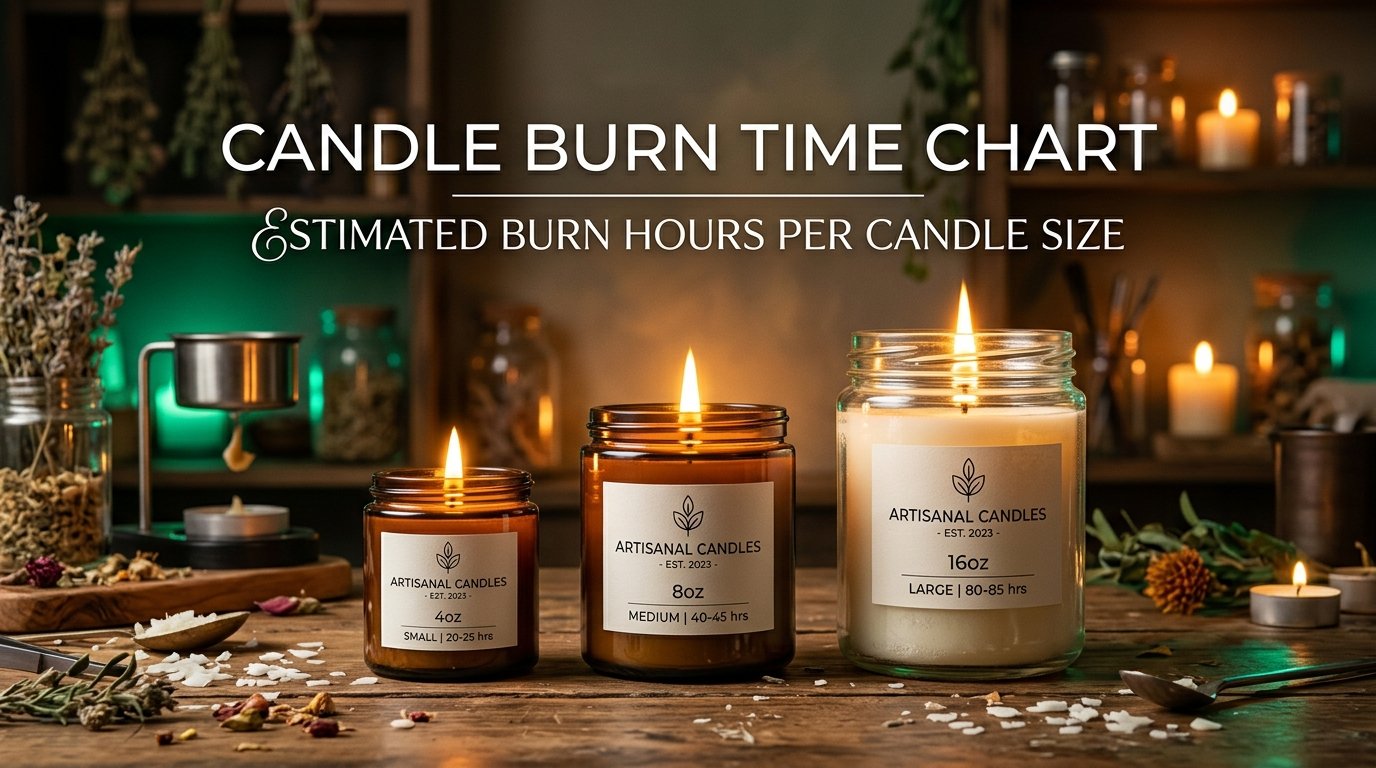
Candle burn time chart reference tables provide candle makers and home consumers with exact burn hour benchmarks across popular jar sizes and wax formulations.
Understanding burn rates across soy, beeswax, coconut, and paraffin waxes ensures accurate product labeling and consistent customer burn safety.
Candle Burn Time Chart by Jar Size & Wax Type (Quick Reference)
Burn time depends primarily on wax density, wick configuration, and container volume. As a baseline standard: Soy wax yields 5 to 7 hours per ounce, Paraffin yields 4 to 5 hours per ounce, and Beeswax yields 7 to 9 hours per ounce.
| Jar Size / Fill | Paraffin Wax | Soy Wax (GW 464) | Beeswax | Multi-Wick Jars |
|---|---|---|---|---|
| 4 oz Mini Jar (~115g) | 15 – 20 Hours | 20 – 25 Hours | 25 – 30 Hours | N/A (Single wick) |
| 8 oz Standard Jar (~225g) | 30 – 40 Hours | 40 – 50 Hours | 50 – 60 Hours | 28 – 35 Hours (2-Wick) |
| 12 oz Medium Jar (~340g) | 50 – 60 Hours | 60 – 75 Hours | 75 – 90 Hours | 45 – 55 Hours (2-Wick) |
| 16 oz Large Single-Wick (~450g) | 65 – 80 Hours | 80 – 100 Hours | 100 – 120+ Hours | N/A |
| 16+ oz 3-Wick Bowl (~450g) | 40 – 50 Hours | 45 – 60 Hours | 60 – 75 Hours | 3 Flames = Faster Burn |
Table of Contents
1. Master Candle Burn Time Chart: Hours by Jar Size and Wax Type
Different candle waxes combust at contrasting speeds due to differences in natural fatty acid structures and melt points.
Review this comprehensive candle burn time chart to determine realistic burn duration expectations across standard commercial containers.
| Container Size | Net Wax Weight | Soy Wax (GW 464) | Beeswax (Pure) | Coconut Apricot | Paraffin (IGI 4630) |
|---|---|---|---|---|---|
| 2 oz Travel Tin / Votive | 1.5 oz (43 g) | 10 – 14 Hours | 14 – 18 Hours | 11 – 15 Hours | 8 – 12 Hours |
| 4 oz Jelly Jar / Tin | 3.2 oz (91 g) | 20 – 25 Hours | 28 – 35 Hours | 22 – 27 Hours | 16 – 20 Hours |
| 8 oz Standard Tumbler | 6.8 oz (193 g) | 40 – 50 Hours | 55 – 65 Hours | 44 – 52 Hours | 32 – 40 Hours |
| 12 oz Medium Glass Jar | 10.2 oz (289 g) | 60 – 72 Hours | 80 – 95 Hours | 65 – 75 Hours | 48 – 58 Hours |
| 16 oz Apothecary Jar | 13.6 oz (386 g) | 80 – 96 Hours | 105 – 125 Hours | 85 – 102 Hours | 64 – 80 Hours |
Consulting an accurate candle burn time chart ensures your retail product labels set clear and reliable consumer expectations.
Crafters looking to calculate exact container wax fill quantities can also utilize our free candle wax calculator.
2. The 7 Critical Conditions That Determine Candle Burn Time
Candle longevity depends upon multiple chemical, thermal, and mechanical variables interacting simultaneously during combustion.
Here are the 7 critical conditions that govern every data point on our candle burn time chart.
Condition 1: Wick Sizing and Braid Geometry
The wick functions as the engine drawing liquefied fuel upward through capillary action into the active flame zone.
An oversized wick creates high combustion temperatures, vaporizing wax rapidly and shortening overall burn lifespan dramatically.
Refer to our specialized candle wick size calculator to match wick series with specific jar diameters correctly.
Condition 2: Wax Polymer Chemistry and Melting Point
Waxes possess distinct molecular densities, varying from light crystalline paraffins to extremely dense natural beeswax compounds.
Dense beeswax requires higher thermal energy to melt, yielding the longest total lifespan on our candle burn time chart.
Selecting premium natural waxes ensures extended enjoyment and cleaner household ambient air quality.
Condition 3: Fragrance Oil Loading and Viscosity
Adding synthetic fragrance oils or botanical essential oils alters fuel viscosity and flame combustion characteristics.
Fragrance loads above ten percent increase pool liquidity, slightly accelerating fuel consumption during extended burn cycles.
Consult our professional candle fragrance calculator to ensure oil ratios remain within verified safety parameters.
Condition 4: Vessel Geometry and Thermal Retention
Thick ceramic containers retain ambient thermal energy longer than thin aluminum tins, maintaining larger liquid melt pools.
Wide jars with multiple wicks consume fuel faster than tall, narrow containers of identical total wax volume.
Container shape plays a decisive role in verifying figures from any standardized candle burn time chart.
Condition 5: Ambient Air Drafts and Oxygen Circulation
Air turbulence from ceiling fans, open windows, or heating vents causes the candle flame to flicker erratically.
A flickering flame draws unburned fuel unevenly, generating unwanted soot and consuming wax up to thirty percent faster.
Burning candles in draft-free zones preserves steady flame symmetry and maximizes overall product lifespan.
Condition 6: Curing Time and Molecular Crystallization
Natural plant waxes require adequate resting time for fatty acid crystal lattices to cure and stabilize fully.
Burning a freshly poured soy candle prematurely results in uneven melt pools and reduced total burning endurance.
Allowing soy candles a full two-week cure time ensures performance aligns with our candle burn time chart.
Condition 7: Burn Cycle Duration and ASTM Safety Limits
Burning a container candle for longer than 4 consecutive hours overheats the vessel and accelerates fuel depletion.
Standard safety guidelines from National Candle Association fire safety standards mandate extinguishing flames after 4 hours.
Observing strict 4-hour cycles prevents dangerous glass cracking and preserves optimal wick capillary efficiency.
3. Multi-Wick Container Lifespan: Double and Triple Wick Dynamics
Wide-diameter vessels exceeding three and a half inches require multiple wicks to achieve complete edge-to-edge melt pools.
Adding a second or third wick increases ambient scent throw significantly but increases fuel consumption per hour.
| Container Format | Net Wax Weight | Wick Configuration | Typical Hourly ROC | Total Burn Lifespan |
|---|---|---|---|---|
| 14 oz Modern Tumbler | 11.5 oz (326 g) | Double Wick (Cotton) | 5.8 g / Hour | 52 – 58 Hours |
| 16 oz Ceramic Bowl | 13.5 oz (382 g) | Triple Wick (Cotton) | 8.2 g / Hour | 44 – 50 Hours |
| 18 oz Oval Vessel | 15.0 oz (425 g) | Double Wood Wick | 6.4 g / Hour | 62 – 68 Hours |
Consulting our candle burn time chart helps artisans explain why multi-wick containers yield slightly lower total burn hours.
The trade-off provides rapid fragrance dispersion across large living spaces while maintaining complete melt pool uniformity.
4. Wax Chemistry Impact on Candle Burn Lifespans
Understanding fuel chemistry helps artisans make informed formulation choices that extend product burn hours.
Examining our master candle burn time chart demonstrates that wax composition represents the primary determinant of total longevity.
Pure Beeswax: The Longest-Burning Natural Fuel
Beeswax possesses an exceptionally high melting point of sixty-two to sixty-four degrees Celsius.
Its complex long-chain esters burn with high radiant efficiency, delivering significantly slower consumption rates than alternative waxes.
Soy Wax (Golden Wax 464 & NatureWax C-3)
Hydrogenated soybean oil creates dense crystalline structures that hold fragrance exceptionally well while burning slowly and cleanly.
Soy candles consistently achieve five to seven hours of burn time per net ounce of poured wax.
Paraffin Wax (IGI 4630 & 4627)
Refined petroleum wax melts at lower temperatures, creating vibrant color saturation and powerful cold scent throw.
However, lower hydrocarbon molecular density causes paraffin to burn roughly twenty percent faster than natural vegetable waxes.
Comparing wax characteristics on our candle burn time chart allows artisans to engineer custom hybrid blends tailored to target burn goals.
5. The ASTM 4-Hour Test Burn Method: Calculating Real Burn Rates
Commercial candle makers must conduct rigorous empirical testing rather than guessing burn hours on product packaging.
Official consensus protocols established by ASTM International standard F2417 define standard four-hour test cycles.
Conducting standardized burns confirms that real workshop batches match the benchmarks listed on our candle burn time chart.
First, weigh your candle on a calibrated digital gram scale and record the exact starting weight.
Light the candle in a draft-free testing room and allow it to burn uninterrupted for exactly 4 hours.
Extinguish the flame, allow the wax pool to solidify completely, and record the ending weight.
Subtracting the ending weight from the starting weight and dividing by four calculates your hourly rate of consumption.
Makers wanting an interactive calculator tool can also use our dedicated candle burn time calculator.
6. Common Crafting Mistakes That Distort Expected Burn Hours
Several frequent artisanal crafting missteps prevent candles from achieving the full longevity promised on our candle burn time chart.
Addressing these common pitfalls ensures every handcrafted candle burns evenly from initial light to final base layer.
The Memory Ring Trap: Extinguishing a candle before the liquid pool touches the container walls creates permanent tunneling, wasting sixty percent of available wax.
Furthermore, failing to trim wicks before relighting causes excessive carbon buildup, creating smoky oversized flames that consume fuel excessively.
Observing strict manufacturing standards from the U.S. Consumer Product Safety Commission protects customers against thermal flare-ups.
Careful temperature control during fragrance addition prevents aromatic solvents from evaporating prematurely during cooling cycles.
7. Essential Quality Checklist for Maximum Candle Longevity
Follow these 4 essential candle care guidelines to maximize the total burn hours outlined on our candle burn time chart.
Step 1: Trim Wick Regularly
Trim the cotton or wood wick to one-quarter inch before each lighting to maintain clean, steady flame height.
Step 2: Complete the First Burn
Burn for two to four hours on the initial light until melted wax extends across the entire container diameter.
Step 3: Eliminate Air Drafts
Position candles away from drafty windows, air vents, and ceiling fans to prevent rapid, uneven wax consumption.
Step 4: Cease at Half-Inch Mark
Discontinue burning when one-half inch of wax remains to avoid thermal stress on the container glass base.
Adhering to these simple practices ensures your candles deliver the complete burn lifespan documented in our candle burn time chart.
8. Frequently Asked Questions on the Candle Burn Time Chart
How many hours does an 8 oz candle typically burn?
An eight-ounce candle made from soy wax burns for approximately forty to fifty hours under proper trimming conditions.
Which candle wax type provides the longest burn time?
Pure beeswax burns the longest of all commercial waxes due to its high melting point and dense molecular density.
Why is my candle burning down much faster than expected?
An oversized wick or burning in drafty environments accelerates wax consumption, reducing expected burn duration significantly.
Does fragrance oil concentration reduce total candle burn hours?
Heavy fragrance loads increase fuel pool liquidity slightly, which can moderately decrease total burn lifespan during long cycles.
How often should I conduct 4-hour test burns on candle batches?
Test burns should be conducted whenever modifying wax suppliers, jar styles, fragrance blends, or wick series lines.
Pingback: How to Calculate Fragrance Oil for Candles: Best Scent Load Formula Guide [2026]
Pingback: Candle Wax Density Chart: Best Container Volume Guide [2026]