
How to Calculate Social Media Earnings: 2026 YouTube, TikTok & Reels Guide
Direct Answer • 2026 Creator Math
Cross-Platform Monetization Formula
RPM × (Qualified Views ÷ 1,000)
How do you calculate social media earnings? Calculate base ad revenue with the standard formula: Earnings = (Qualified Views ÷ 1,000) × RPM. Industry average RPM benchmarks in 2026: YouTube Long-Form: $4.00–$18.00; TikTok Creator Rewards: $0.50–$1.20 (eligible 1-minute+ videos); YouTube Shorts: $0.04–$0.08. Then add direct income: Brand Deals ($20–$35 per 1k followers) + Affiliate Commissions (10%–30%). Model your potential payouts instantly with our Social Media Money Calculator.
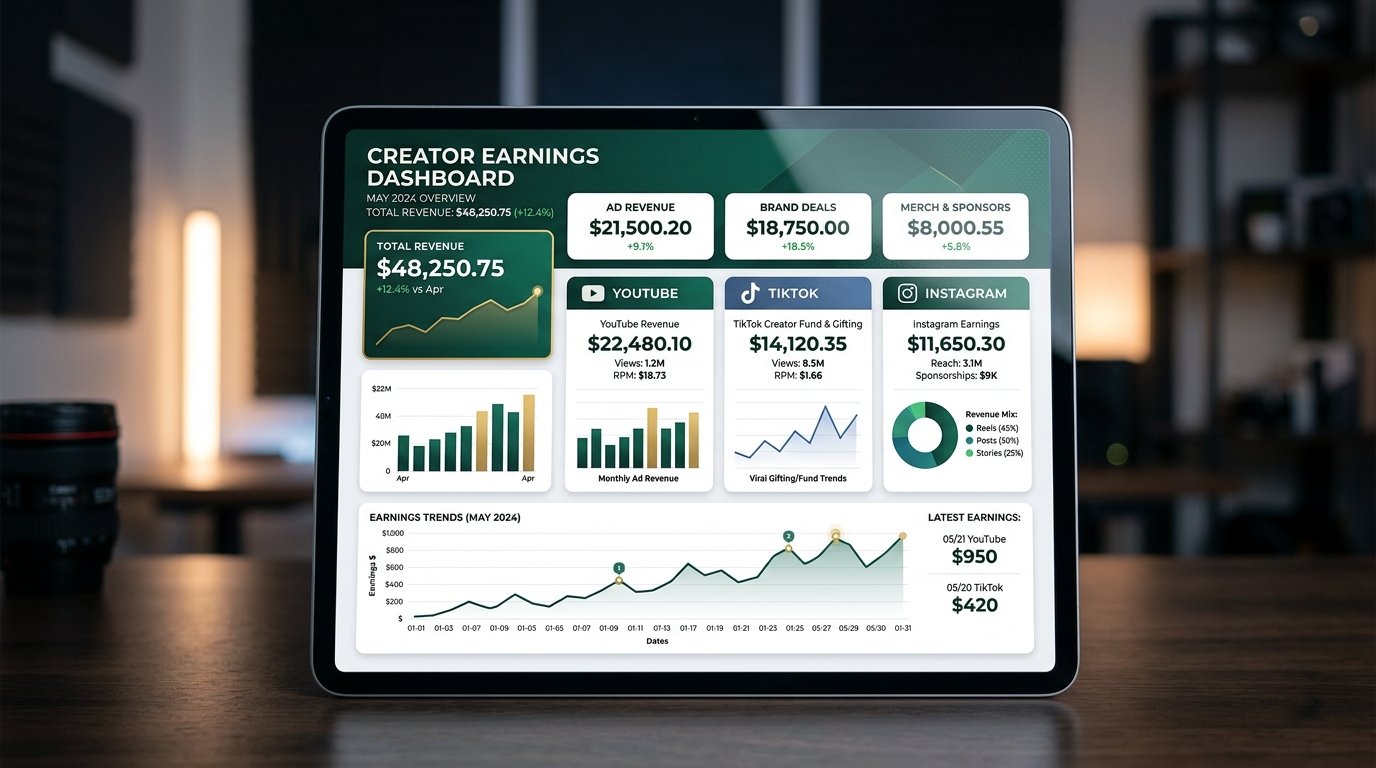
Visual guide: Determining how to calculate social media earnings across YouTube, TikTok, and Instagram.
Wondering how to calculate social media earnings or searching for a reliable social media money calculator? Learning how to calculate social media earnings across YouTube, TikTok, and Instagram is the foundation of turning content creation into a full-time career.
Many creators mistakenly believe that high view counts automatically equate to massive paychecks. However, actual income depends on RPM rates, niche advertiser bidding, viewer geography, and sponsorship deals.
In this comprehensive creator guide, you will master how to calculate social media earnings using exact monetization formulas. We explore platform payout matrices, worked real-world scenarios, and our free social media money calculator.
Want Instant Revenue Projections for Your Channel?
Skip complex ad rate conversions. Select your niche and enter your monthly views to calculate exact RPM payouts and brand sponsorship values instantly.
Table of Contents
1. Core Mathematical Formulas: How to Calculate Social Media Earnings via CPM & RPM
To master how to calculate social media earnings, you must understand the critical difference between gross advertiser cost (CPM) and net creator revenue (RPM).
CPM stands for Cost Per Mille, which is the dollar amount advertisers bid to display 1,000 ad impressions. According to official monetization documentation from the YouTube Partner Program, platforms take a revenue share before creators get paid.
On YouTube, creators receive 55% of net ad revenue on long-form video, while YouTube retains 45%. On YouTube Shorts, creators share a 45% revenue pool.
RPM (Revenue Per Mille) measures total earnings per 1,000 total video views, including non-monetized views. RPM represents the true metric you must track.
Estimated Ad Earnings ($) = [Total Monetized Views ÷ 1,000] × Channel RPM ($)
Step 2: Effective RPM Calculation:
True RPM ($) = [Total Net Monthly Earnings ($) ÷ Total Channel Views] × 1,000
Research published by Statista shows the global creator economy exceeds $250 billion. However, top-earning creators diversify beyond platform ad revenue into sponsorships and merchandise.
The Monetized Playback Percentage (MPP) Factor
A common misconception when learning how to calculate social media earnings is assuming that every single video view displays an advertisement.
In reality, ad blockers, viewer geography, and platform ad auction limits mean only 45% to 65% of total views represent monetized playbacks.
Furthermore, YouTube Premium subscribers do not see banner or pre-roll ads. Instead, YouTube distributes a proportion of subscription fees based on member watch time.
Testing your metrics in an online social media money calculator automates these multi-platform conversions. It prevents inaccurate earnings forecasts.
2. Global Platform Matrix: How to Calculate Social Media Earnings Across Networks
Each major network operates an entirely distinct payment algorithm. This benchmark matrix outlines how to calculate social media earnings across YouTube, TikTok, and Instagram:
| Platform & Format | Payout Mechanism | Average RPM Range | Earnings Per 100k Views | Primary Revenue Source |
|---|---|---|---|---|
| YouTube Long-Form (8+ min) | Google AdSense (55% Share) | $3.50 – $18.00 | $350 – $1,800 | Mid-roll pre-roll video ads |
| YouTube Shorts (Vertical) | Shorts Ad Pool (45% Share) | $0.04 – $0.15 | $4.00 – $15.00 | Shared feed interstitial ads |
| TikTok Creator Rewards Program | 1-Minute+ Qualified Views | $0.40 – $1.20 | $40 – $120 | Qualified search & FYP views |
| Instagram Reels / Feed | Brand Deals & Affiliate | $0.00 AdSense Native | $250 – $1,200 (Sponsor) | Direct brand sponsorships |
| TikTok Shop Affiliate Showcase | Commission on Product Sales | 10% – 20% GMV | $500 – $3,500 (Sales) | Product sales commissions |
Notice that 100,000 views on YouTube long-form generate up to 100 times more ad revenue than YouTube Shorts. Short-form video drives massive reach, but long-form video drives reliable income.
Using a social media money calculator helps creators balance short-form top-of-funnel reach with high-earning long-form video production.
Niche RPM Benchmarks Across Content Categories
Advertiser bidding varies radically by content category. When evaluating how to calculate social media earnings, niche selection is paramount:
| Content Niche | Average RPM Range | Target Audience Intent | Top Paying Advertisers |
|---|---|---|---|
| Personal Finance & Crypto | $15.00 – $35.00 | High commercial intent | Brokerages, Banks, Credit Cards |
| B2B Software & Tech Tutorials | $9.00 – $18.00 | Professional decision makers | SaaS tools, Cloud platforms |
| Fitness & Home Workouts | $3.50 – $7.50 | Consumer lifestyle buyers | Supplements, Apparel, Gym apps |
| Gaming & Reaction Clips | $1.20 – $3.00 | Casual entertainment seekers | Energy drinks, Mobile games |
3. Step-by-Step Worked Scenarios: How to Calculate Social Media Earnings in Practice
To see how to calculate social media earnings across real channels, let us evaluate four practical creator case studies.
Scenario A: Tech & Software Reviewer (YouTube Long-Form)
A tech creator publishes 4 in-depth software tutorials monthly, generating 180,000 views. In tech niches, advertisers bid premium CPMs:
- Monthly Video Views: 180,000 views.
- Tech Niche Channel RPM: $11.50 per 1,000 views.
- AdSense Ad Income: (180,000 ÷ 1,000) × $11.50 = $2,070 / month.
- Integrated Software Sponsorship: 2 videos sponsored at $1,200 each = $2,400 / month.
- SaaS Affiliate Recurring Commissions: $950 / month.
- Total Monthly Earnings: $2,070 + $2,400 + $950 = $5,420 / month ($30.11 effective RPM).
Scenario B: Viral Comedy Creator (TikTok Creator Rewards Program)
A short comedy sketch creator generates 3,500,000 monthly views on TikTok with 1-minute+ videos:
- Total Monthly Views: 3,500,000 views.
- Qualified Monetized Views (60% Retention): 2,100,000 views.
- Entertainment Tier RPM: $0.62 per 1,000 qualified views.
- Creator Rewards Payout: (2,100,000 ÷ 1,000) × $0.62 = $1,302 / month.
- TikTok Live Stream Gifts: $450 / month.
- Combined Monthly Take-Home: $1,752 / month.
Scenario C: Lifestyle & Fitness Creator (Instagram + Brand Deals)
An Instagram fitness influencer has 45,000 engaged followers with an average reel view count of 25,000:
- Follower Count: 45,000 followers (Engagement rate: 4.8%).
- Dedicated Sponsored Reel Rate: $650 per reel × 3 brands = $1,950 / month.
- Supplements Affiliate Code Sales: $820 / month.
- Workout PDF Guide Digital Sales: 40 sales at $25 = $1,000 / month.
- Total Monthly Creator Earnings: $3,770 / month.
Scenario D: TikTok Shop Affiliate & Live Stream Seller
A creator leverages TikTok Shop showcase videos and weekly live shopping sessions to earn high affiliate commissions:
- Monthly Video Views: 850,000 product showcase views.
- Gross Merchandise Value (GMV) Driven: $28,000 in monthly sales.
- Average Affiliate Commission Rate (15%): $28,000 × 0.15 = $4,200 / month.
- Creator Rewards Video Fund Payout: $380 / month.
- Live Stream Brand Gift Tips: $290 / month.
- Total Monthly Affiliate Earnings: $4,870 / month.
Reviewing these scenarios proves that learning how to calculate social media earnings requires looking past vanity view metrics. Niche selection and audience intent matter far more than sheer view counts.
4. Demographic Physics & Niche Advertiser Bidding Economics
Two videos with identical 100,000 view counts can earn vastly different amounts. When determining how to calculate social media earnings, CPM variance is governed by three primary pillars:
The 3 Pillars of Content Valuation:
- Commercial Niche Value: Personal finance, real estate, and B2B software command $18-$40 RPMs because customer acquisition values are high. Gaming, memes, and prank content generate $1.50-$3.00 RPMs.
- Audience Geographic Location (Tier 1 vs Tier 3): Views from the US, UK, Canada, and Australia bid 5x to 15x higher ad rates than views from developing markets.
- Viewer Age Demographics: Viewers aged 25-45 with discretionary spending power attract premium auto and insurance advertisers. Teen audiences yield lower bid prices.
Seasonality also exerts a massive influence when evaluating how to calculate social media earnings. During Q4 (holiday retail season), advertiser spending peaks, boosting RPMs by 40% to 70%.
When learning how to calculate social media earnings, note that in January (Q1), advertising budgets reset, causing a temporary 30% to 50% drop in daily ad revenue across all platforms.
5. Sponsorship Valuation & FTC Legal Compliance Standards
Brand sponsorships often form over 60% of a successful creator’s annual revenue. Mastering how to calculate social media earnings for brand collaborations requires standard rate card formulas.
YouTube 60-Sec Integration: $20 to $45 per 1,000 projected views.
Dedicated YouTube Video: $60 to $100 per 1,000 projected views.
Instagram Sponsored Reel: $15 to $35 per 1,000 average reel views.
TikTok Dedicated Post: $10 to $25 per 1,000 average views.
From a regulatory perspective, the Federal Trade Commission (FTC) enforces strict disclosure laws. Creators must clearly disclose paid endorsements using visible #ad or #sponsored tags before the fold.
Failing to disclose sponsored products can result in substantial fines and platform strikes that jeopardize your monetization status.
Usage Rights & Whitelisting Multipliers
Savvy creators monetize brand deals beyond organic post views. When a brand requests whitelisting rights (Meta Partnership Ads or TikTok Spark Ads), charge additional usage fees.
Industry standards dictate adding a 30% to 50% licensing surcharge for 30 days of paid ad distribution rights.
Adding usage rights can transform an $800 sponsored video into a $1,200 deal without requiring additional filming or creative production.
6. 5 Costly Monetization Mistakes When You Calculate Social Media Earnings
Many full-time content creators struggle financially because they miscalculate revenue. Avoid these five critical mistakes when learning how to calculate social media earnings:
- 1. Chasing Viral Views Over Commercial Intent: A viral video in an entertainment niche earning 1 million views at a $0.50 RPM pays $500. A targeted B2B video with 50,000 views at a $20 RPM pays $1,000.
- 2. Single-Platform Dependency: Algorithms shift overnight. Using a social media money calculator to distribute content across YouTube, newsletters, and TikTok safeguards your income.
- 3. Forgetting Self-Employment Taxes: Creators are independent contractors. Always set aside 25% to 30% of gross earnings for income and self-employment taxes.
- 4. Neglecting Email List Ownership: You do not own your social media followers. Converting social viewers into an email list creates an asset that algorithms cannot touch.
- 5. Ignoring Video Retention Graphs: Videos with higher average percentage viewed (APV) trigger multiple mid-roll ad placements, multiplying your effective RPM.
7. Frequently Asked Questions: How to Calculate Social Media Earnings
How much does YouTube pay for 1 million views?
On long-form YouTube videos, 1 million views typically pays between $2,500 and $12,000 depending on the channel’s niche, viewer demographics, and video length. On YouTube Shorts, 1 million views pays between $40 and $150.
How does TikTok calculate creator rewards payouts?
TikTok pays through its Creator Rewards Program for original videos longer than 1 minute. Payouts are based on qualified views (views lasting at least 5 seconds from unique users), search intent, and audience region, averaging $0.40 to $1.10 RPM.
Does Instagram pay creators directly for reel views?
Meta has phased out the Reels Play bonus program in most regions. Instagram creators primarily generate income through direct brand sponsorships, affiliate marketing links, and selling products via Instagram Shop.
What is the most profitable niche on social media?
Personal finance, investing, software reviews, cryptocurrency, and real estate are the highest-paying niches, generating RPMs between $15.00 and $45.00 due to fierce competition among financial services advertisers.
How long does a video take to reach its peak earnings?
On TikTok and Instagram, videos generate 85% of their total revenue within the first 72 to 96 hours. On YouTube, evergreen search-optimized videos accumulate consistent ad earnings for 3 to 5 years after publication.
How can creators track diversified social media income streams?
Professional creators use an online social media money calculator alongside dedicated creator bookkeeping tools. Categorize earnings into platform ad revenue, affiliate commissions, brand sponsorships, and digital product sales.
8. Interactive Tool & Creator Revenue Planning
Learning how to calculate social media earnings manually gives you deep insight into digital advertising economics and channel valuation.
Whether you are planning brand pitches or projecting ad revenue for next quarter, mastering how to calculate social media earnings gives you full financial control over your creative business.
By inputting your analytics into our social media money calculator, you can quickly evaluate whether shifting production into higher-RPM niches or sponsored video formats makes economic sense.
Our free online social media money calculator helps you determine how to calculate social media earnings across YouTube ad revenue, TikTok creator payouts, and Instagram sponsorship rates in seconds.