
How to Calculate Candle Burn Time: Best 2026 Complete Testing Guide
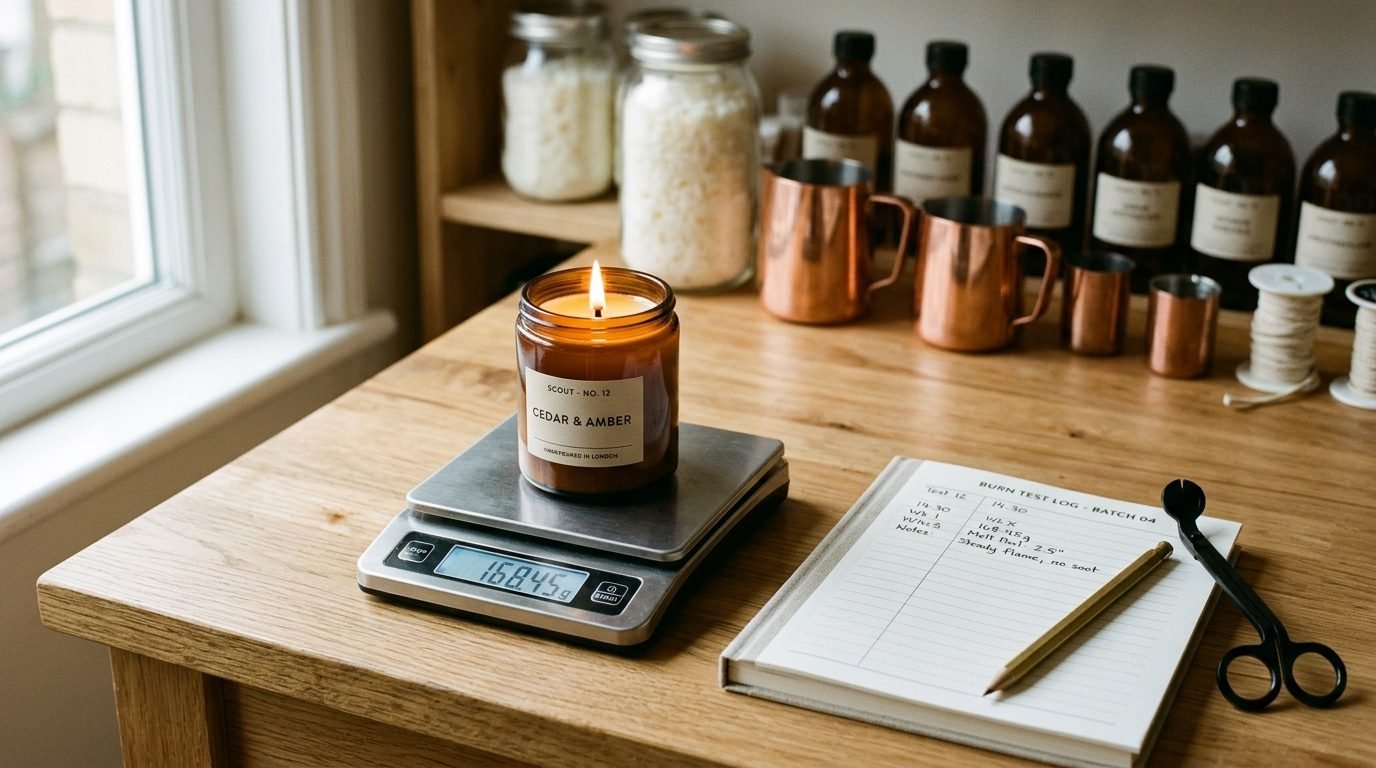
Visual guide: Determining how to calculate candle burn time using ASTM laboratory burn cycles.
Learning how to calculate candle burn time is the single most vital testing skill for professional chandlers and hobbyists alike. When customers purchase an artisan candle, total burn hours represent their primary benchmark of product quality.
However, guessing burn longevity from raw wax weight leads to inaccurate product labels and safety violations. To properly formulate your candle batches before burn testing, calculate your raw materials using our companion Candle Wax Calculator. To properly determine how to calculate candle burn time, you must measure hourly consumption rates through standardized laboratory test burns.
In this definitive guide, you will master how to calculate candle burn time using ASTM protocols. We cover wax consumption formulas, multi-wick dynamics, safety heels, and an interactive candle burn time calculator.
Need Instant Burn Rate Math for Your Candles?
Skip manual scale conversions. Enter your pre-burn and post-burn weights to calculate exact grams per hour and total burn hours instantly.
Table of Contents
1. Core Formulas: How to Calculate Candle Burn Time via ASTM 4-Hour Cycles
To understand how to calculate candle burn time, you must realize that candles consume fuel at a steady rate of mass per hour. This metric is known as the Rate of Consumption (ROC).
Standardized safety protocols established by ASTM International (specifically ASTM F2417 for candle fire safety) require test burns to be conducted in four-hour intervals.
Testing in four-hour blocks mirrors real consumer behavior. It prevents excessive vessel overheating while ensuring a complete melt pool forms across the container diameter.
Chandlers often ask why a single continuous burn cannot determine lifespan. Burning a candle continuously for 12 hours causes dangerous heat accumulation.
When container walls heat up beyond 140°F, the entire wax surface liquefies prematurely. This results in an artificially fast burn rate that does not reflect normal usage.
By following strict 4-hour cycles with 2-hour cooling rest periods, you record true real-world consumption figures for your safety labels.
ROC (g/hr) = [Initial Weight (g) − Final Weight (g)] ÷ Test Burn Duration (Hours)
Step 2: Total Burn Lifespan Formula:
Total Burn Time (Hours) = Net Usable Wax Weight (g) ÷ ROC (g/hr)
A common blunder when evaluating how to calculate candle burn time is using gross vessel weight. You must subtract both container tare weight and the safety heel.
Fire safety guidelines from the National Candle Association (NCA) mandate leaving a half-inch (12.7 mm) safety heel of unburned wax at the bottom. This prevents glass fracturing.
Net Usable Wax = Total Poured Wax Weight − Safety Heel Wax Weight
(Rule of thumb: Safety heel accounts for 8% to 12% of total fill weight).
Using an online candle burn time calculator automates these mathematical conversions. It prevents mathematical errors that could compromise fire safety warnings.
2. Wax & Wick Matrix: How to Calculate Candle Burn Time Across Formulations
Different wax bases possess unique molecular densities, crystal structures, and melt temperatures. These chemical factors dictate how to calculate candle burn time across popular commercial wax formulas.
| Wax Type & Blend | Melt Point | Avg Burn Rate (g/hr) | Expected 8oz Burn | Ideal Wick Series |
|---|---|---|---|---|
| Golden Wax 464 (100% Soy) | 115°F – 120°F | 4.2 – 4.8 g/hr | 45 – 52 Hours | CD, ECO, Premier 700 |
| IGI 4630 (Paraffin Container) | 119°F | 5.1 – 5.8 g/hr | 36 – 42 Hours | Zinc Core, HTP, Cotton |
| Coconut Apricot Luxury Wax | 125°F | 3.8 – 4.4 g/hr | 50 – 58 Hours | Wooden Booster, CD, Crackling |
| 100% Pure Filtered Beeswax | 144°F – 147°F | 3.2 – 3.7 g/hr | 60 – 70 Hours | Square Braid Cotton, Heavy Flat |
| Rapeseed & Coconut Blend | 120°F – 126°F | 4.0 – 4.6 g/hr | 48 – 55 Hours | TCR, ECO, Stabilo |
Pure beeswax has a dense carbon chain and high melting point. It burns slowest of all waxes, producing exceptional burn time if wicked with high-output square braids.
Conversely, paraffin possesses a faster combustion velocity. It produces intense fragrance throw while burning through its fuel reservoir significantly faster than vegetable waxes.
Container Diameter & Wicking Thresholds
Container diameter directly governs melt pool coverage. Choosing between a single large wick and multiple smaller wicks fundamentally alters hourly fuel draw:
| Vessel Diameter | Wick Configuration | Avg Hourly Draw | Tunneling Risk |
|---|---|---|---|
| Under 2.5 Inches (Votives/Tins) | Single Small Wick (ECO 2 / CD 6) | 2.5 – 3.2 g/hr | Very Low |
| 2.5 to 3.25 Inches (Standard Tumblers) | Single Medium Wick (CD 12 / ECO 8) | 4.2 – 4.8 g/hr | Moderate if underwicked |
| 3.25 to 4.0 Inches (Wide Jars) | Double Wick (Dual ECO 4 / CD 4) | 6.0 – 7.5 g/hr | Low with dual wicks |
| Over 4.0 Inches (Centerpiece Bowls) | Triple Wick (Tri-CD 4 / Tri-HTP 52) | 8.2 – 10.5 g/hr | High if spacing is narrow |
3. Step-by-Step Worked Scenarios: How Many Hours Do Candles Burn in Practice?
Let us examine three real-world test burns to demonstrate exactly how to calculate candle burn time with precision instruments.
Scenario A: Single-Wick 8 oz Soy Candle (Golden Wax 464)
An artisan crafts an 8 oz straight-sided amber jar poured with 200 grams of scented soy wax, wicked with a CD 12 wick.
- Tare Jar + Wax (Pre-Burn): 385.0 grams.
- Weight After 4-Hour Test Burn: 367.4 grams.
- Wax Consumed: 385.0 − 367.4 = 17.6 grams.
- Hourly Rate of Consumption: 17.6 g ÷ 4 hours = 4.4 grams/hour.
- Net Usable Wax: 200 g poured − 20 g safety heel = 180 grams.
- Estimated Total Burn Time: 180 g ÷ 4.4 g/hr = 40.9 Hours (Round down to 40 hours for safety).
Scenario B: 14 oz 3-Wick Coconut-Soy Luxury Vessel
Wide diameter vessels (over 3.5 inches) require multi-wicking to prevent tunneling. Here is how to calculate candle burn time for a triple-wick design:
- Net Usable Wax: 350 grams (after deducting 35g safety heel).
- Initial Weight Before Burn 1: 612.0 grams.
- Final Weight After 4 Hours: 578.4 grams.
- Wax Consumed: 33.6 grams across 3 flames.
- Composite Burn Rate: 33.6 g ÷ 4 hrs = 8.4 grams/hour (2.8 g/hr per wick).
- Total Projected Burn Time: 350 g ÷ 8.4 g/hr = 41.6 Hours.
Scenario C: 4 oz Travel Tin Paraffin Candle
Compact aluminum tins trap heat quickly, which influences how to calculate candle burn time:
- Net Usable Wax: 90 grams.
- Weight Consumed in 4-Hour Test: 15.2 grams.
- Hourly Burn Rate: 15.2 g ÷ 4 = 3.8 grams/hour.
- Total Lifespan: 90 g ÷ 3.8 = 23.6 Hours (Certified label claim: 20-22 hours).
Understanding how to calculate candle burn time with these worked scenarios ensures you never overstate performance on customer packaging.
4. Combustion Chemistry & Fragrance Load Impact on Burn Longevity
A candle flame is an open thermodynamic siphon. Liquid wax is drawn up through wick fibers by capillary pressure, vaporizing at 572°F (300°C) within the dark inner core of the flame.
When you determine how to calculate candle burn time, fragrance oil (FO) percentage represents the most volatile variable. Synthetic fragrance compounds lower the overall flash point and alter viscosity.
The Fragrance Concentration Burn Curve:
- 0% Unscented Wax: Baseline burn rate. Dense, uniform laminar flame with minimal wick carbonization.
- 6% Moderate Fragrance Load: 5% to 8% increase in hourly wax consumption due to lowered surface tension.
- 10% Heavy Fragrance Load: 12% to 18% increase in burn rate. Excess volatile esters can cause flame flare and carbon mushrooming.
Another critical factor when learning how to calculate candle burn time is melt pool depth. A proper melt pool should measure between 1/4 inch and 1/2 inch in depth at the 4-hour mark.
If the pool exceeds 1/2 inch, the wick is pulling excessive fuel, shortening overall candle life. If under 1/4 inch, the flame risks drowning in unmelted wax walls.
Liquid candle dyes and color blocks also introduce insoluble particulates. These fine pigments can slowly clog wick capillaries over multiple burns.
When wick flow is restricted by heavy dye, the flame shrinks. This artificially depresses the hourly burn rate while causing incomplete scent dispersion.
5. Cost Per Hour & Commercial Labeling Compliance Standards
Beyond burn physics, mastering how to calculate candle burn time is essential for profitable retail pricing and legal compliance.
Consumers subconsciously evaluate luxury candle purchases by calculating cost per hour of sensory enjoyment:
Cost Per Hour ($) = Retail Selling Price ($) ÷ Certified Total Burn Hours
Example: $28 Artisan Candle ÷ 45 Burn Hours = $0.62 per hour of ambiance.
From a regulatory standpoint, safety enforcement agencies like the U.S. Consumer Product Safety Commission (CPSC) monitor fire hazard claims.
Under ASTM F2417 regulations, container glass exterior temperatures must never exceed 140°F (60°C). Over-wicking to boost burn claims creates dangerous thermal shock that fractures glass vessels.
Always state a conservative burn range on product labels. If your laboratory test calculations reveal 48 hours of burn time, label your packaging with “Burns 40-45 Hours”.
Under-promising burn hours safeguards your brand reputation against varied customer environments. Drafty rooms or unclipped wicks deplete wax faster than lab baselines.
When customers find that their candle outlasts the stated label hours, brand trust and repeat purchase rates surge dramatically across retail channels.
6. 5 Costly Testing Mistakes When You Calculate Candle Burn Time
Avoiding methodological pitfalls is critical when determining how to calculate candle burn time. Here are the five most common testing mistakes:
- 1. The Single-Burn Extrapolation Fallacy: Assuming the first 4-hour burn rate remains constant down to the jar bottom. As the candle burns lower, trapped heat accelerates consumption.
- 2. Weighing Hot Liquid Wax: Always allow test candles to cool completely back to room temperature before recording post-burn weights on precision digital scales.
- 3. Failing to Trim Wicks to 1/4 Inch: Untrimmed wicks develop carbon mushrooms. This doubles flame size and burns through wax 25% faster than intended.
- 4. Testing in Drafty Rooms: Air drafts from ceiling fans or HVAC vents supply erratic oxygen, causing smoking, flickering, and artificially rapid fuel consumption.
- 5. Overlooking Container Geometry: Tapered vessels possess varying diameters. Burn rates accelerate substantially as the wax pool widens or narrows.
Conducting at least three full 4-hour burn cycles gives you the true average consumption rate when learning how to calculate candle burn time.
7. Frequently Asked Questions: How to Calculate Candle Burn Time
How many hours will an 8 oz soy candle burn?
An 8 oz container holding approximately 180 to 200 grams of net usable soy wax burns for 40 to 50 hours under proper conditions. This assumes an average consumption rate of 4.2 to 4.6 grams per hour and proper 1/4 inch wick trimming.
Why do test burns require 4-hour intervals?
ASTM safety standards mandate 4-hour test cycles because 4 hours is the industry benchmark for safe consumer use. Burning past 4 hours causes excessive container heating, carbon buildup, and accelerated wax vaporization.
How does wick size impact how to calculate candle burn time?
A larger wick draws more liquid fuel per minute. If you jump from a CD 10 to a CD 16 wick, your hourly consumption rate can increase by 30%, reducing a 50-hour candle down to 35 hours while dramatically increasing container heat.
Do wooden wicks burn slower than braided cotton wicks?
Single-ply wooden wicks produce a wide, low flame that burns slightly slower than round braided cotton. However, booster wooden wicks can consume wax at comparable or higher rates depending on wood thickness and vessel diameter.
Can I calculate burn time for freestanding pillar candles?
Yes, but pillar candles require tighter wick sizing because excess heat can breach outer wax walls. Calculate net weight by subtracting the unburned bottom shell (typically 15% to 20% for pillars) to maintain structural containment.
How accurate is a digital candle burn time calculator compared to real testing?
A mathematical calculator provides over 95% accuracy when fed data from standard 4-hour test burns. It eliminates human arithmetic errors and factors in mandatory ASTM safety margins automatically.
8. Interactive Tool & Verification Protocol
Determining how to calculate candle burn time manually is vital for formulation development, but repetitive calculations across product lines waste valuable studio hours.
Using our online candle burn time calculator, you can input wax type, jar dimensions, and test burn weights to get certified burn projections and print-ready product safety figures.